 Thailand
Before we get to specific types of transport, it's worth understanding how Hua Hin is laid out. The resort only seems compact when you look at a map. In reality, it stretches along the coast, and its districts are scattered over considerable distances. In the center is the historic part with the night market and the train station. To the south are Nong Kae with the Cicada Market, Khao Takiab mountain, and the Khao Tao area. North of the city, toward Phetchaburi, is Cha-Am. If you're staying right in the center, most of the places you need (market, train station, beach, cafes) are within walking distance. But many hotels stand along the beach far from the center, and then you'll have to drive even to the nearest cafe. In outlying areas like Khao Tao Beach, without transport you'll be isolated. So you need to choose transport to fit your needs: where you're staying and where you want to go.
There are several ways to get around Hua Hin: on foot in the center, cheap songthaews along the main road, tuk-tuks and moto-taxis for short trips, the Grab and Bolt apps with fixed prices, and finally, renting a motorbike or car for complete freedom. We consider the last option the best for those who want to see not only the beach by their hotel but also the surroundings, waterfalls, temples, and neighboring provinces. Here's a detailed look at each method:
On Foot: When You Don't Need Transport
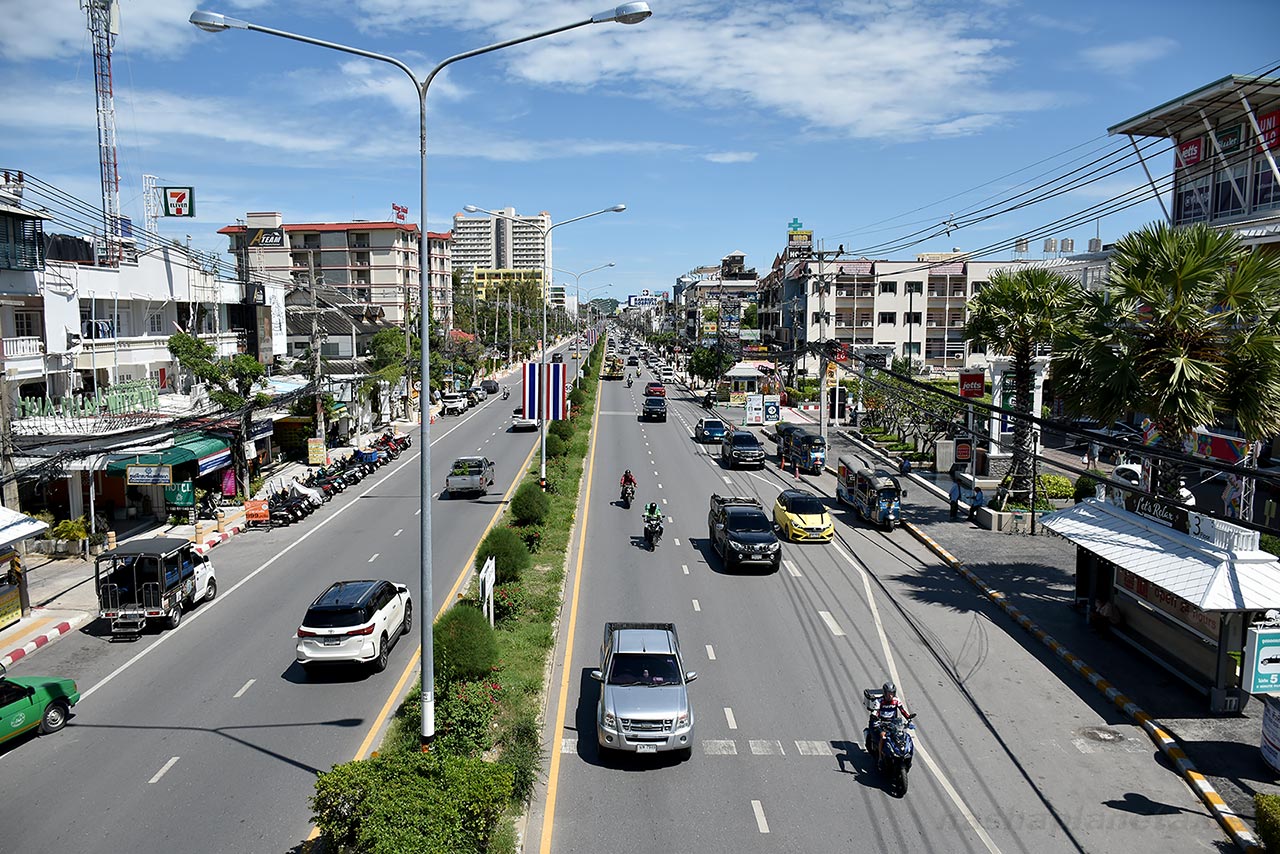
If your hotel is in the historic center, between the clock tower, the night market, and the railway station, you can reach most of the places you need on foot. These spots are scattered within a 15-minute walk of each other, and the local Walking Street, Soi Bintabaht with its bars and restaurants, is right here too. And strolls along the beach are a pleasure in themselves.
But this only works for the center. If your hotel stands along the beach away from the historic part, or especially in a far-off area like Khao Tao, you can't do without transport.
Songthaew: The Cheapest Transport in Hua Hin
A songthaew, or "baht bus," is a converted pickup truck with two benches in the back, exactly like in Pattaya. And you use them the same way, so if you have experience in Pattaya, you won't have any problems here.
In Hua Hin, this is the cheapest and most convenient way to get around the city. You hail the vehicle with a wave of your hand and can get on anywhere. You pay in cash on exit, handing it to the driver through the cab window. No stops or schedules: you just wave, tell the driver the destination, and if he nods, you hop in the back.
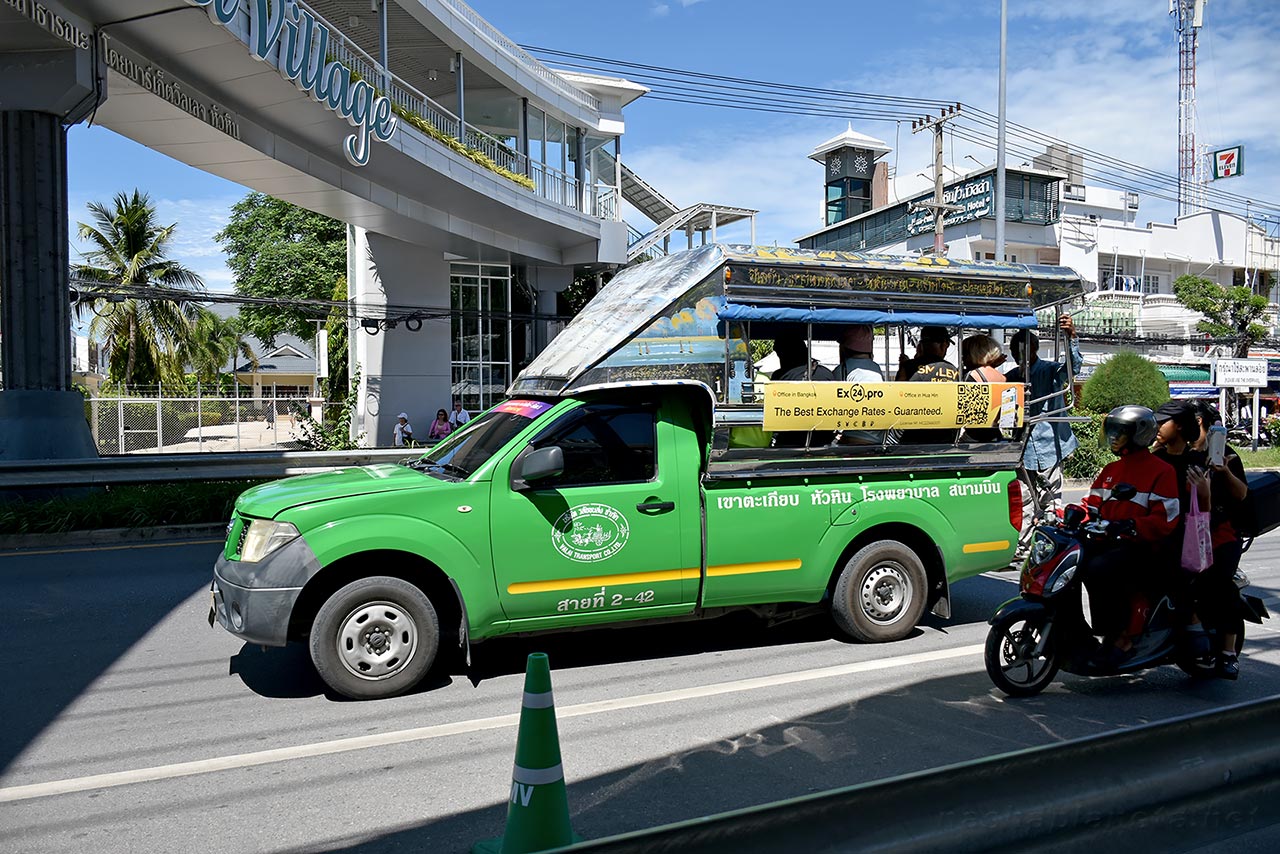
Short trips in the center cost 10-20 baht (0.3-0.6 USD), and you can get to Khao Takiab mountain or the Cicada Market for 30-40 baht (0.9-1.2 USD). That's several times cheaper than a tuk-tuk for the same distance. Drivers barely speak English, but they know the names of the main tourist spots by heart: "Cicada Market," "Night Market," "Khao Takiab," and that's enough.
Important point. As in Pattaya, after 18:00-19:00 songthaews formally keep running, but no longer as fixed-route shuttles – more like taxis: there's no fixed fare, the price immediately jumps to 100-150 baht, and sometimes higher. If you're dining at the night market and returning to a hotel in the Nong Kae area, after 22:00 it's pointless to flag down a songthaew – it's easier to call Grab or take a tuk-tuk. And keep small change handy. Giving change from 500 baht for a 15 baht ride isn't done here, and the driver may simply not have the change.
Main Songthaew Routes
There are four main routes in the city, distinguished by the color of the body. In practice, the color isn't a guarantee of direction, so before getting in, still confirm with the driver.
- Green songthaews (Khao Takiab - Hua Hin Airport). The most useful route for tourists: it runs along the coast through the whole city along Phetkasem Road. It passes the night market, the bus station, Market Village mall, the Cicada Market, and ends at Khao Takiab mountain. They run roughly every 10-15 minutes from 06:00 to 18:00 (in high season sometimes until 21:00). Fare from 15 baht.
- White with a red stripe (city loop). A circular route along the main streets: Thanon Phetkasem, Soi Hua Hin 94, Prapoklao (along the railway), and Soi Hua Hin 41. They run 2-3 times an hour from 07:00 to 21:00, fare from 15 baht.
- Orange (Maegep - Makro). Passes through the city but winds through small side streets. Useful if you need to get to the seated Buddha at Wat Bo Fai. They run 2-3 times an hour, from 07:00 until about 21:00, from 15 baht.
- White (railway station - Huay Mongkol Temple). A long suburban route: it starts from a lot a hundred meters south of the railway station, passes Market Village, the floating markets, and Wat Huay Mongkol temple. They run about once an hour from 08:00 to 18:00. To the floating market 20 baht (0.6 USD), to the temple 40 baht.
Songthaew Routes on the Map
Tuk-Tuks: The Price Is Negotiable, and That's the Main Thing
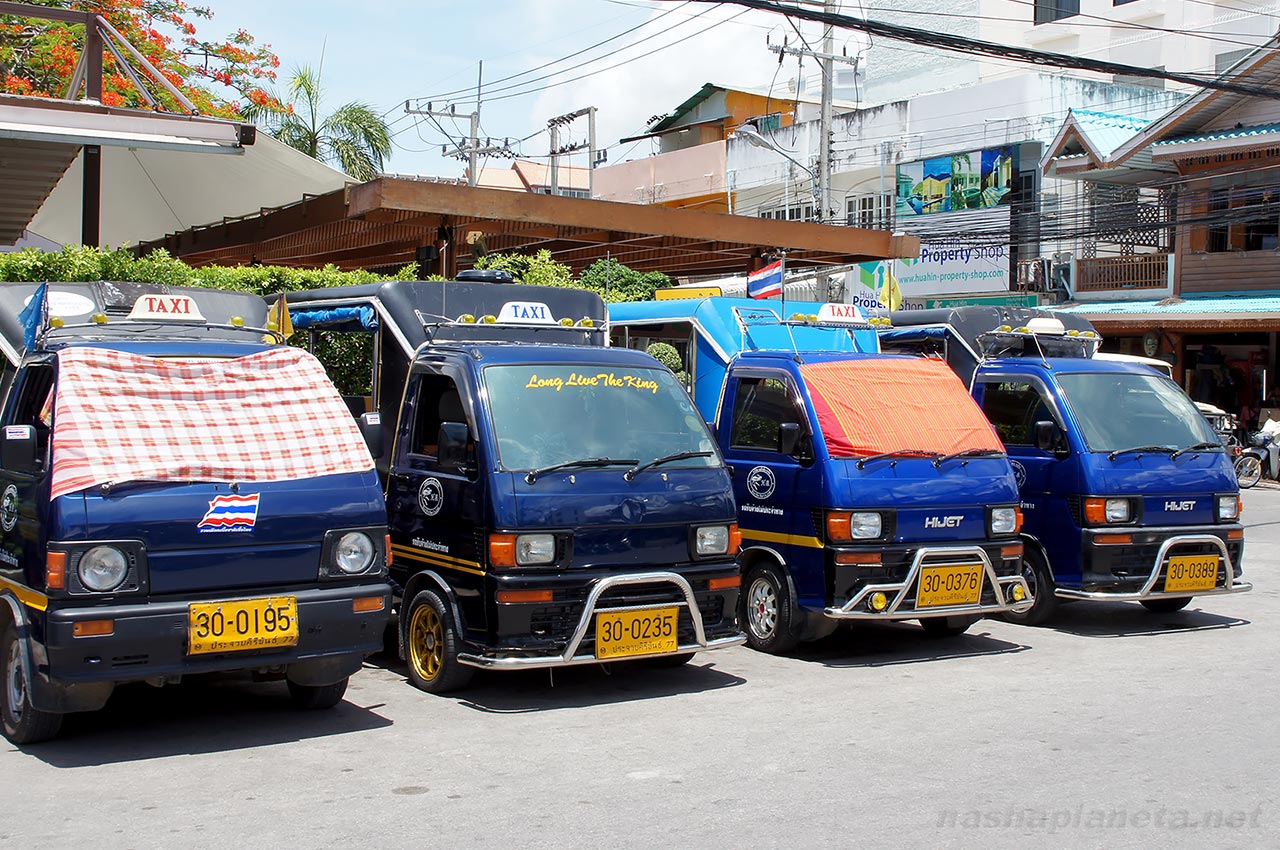
Tuk-tuks in Hua Hin are the same three-wheeled vehicles as in Bangkok. They wait at stands: near markets, shopping malls, and on tourist streets.

They're not shy about asking two to three times the price of a taxi via an app, but they haggle well. A trip around the city (3-6 km) usually costs 80-200 baht (2.4-5.99 USD), but the starting price they quote you might be 300 baht. They rarely ask less than 100 baht from a foreigner, that's effectively the minimum trip price.
The main rule: agree on the price before the trip starts.
Taxis and Apps: Grab, Bolt, InDrive
The price of a short taxi ride in Hua Hin via apps starts from 60 baht (1.8 USD), but that's in good weather during the day when there's no high demand. In the evening, the minimum is already from 100 baht (3.59 USD). Getting to the Cicada Market from the center will cost about 120 baht, and to Hua Hin Airport you can get there for 150-200 baht. Moto-taxis are half the price, but only suit one person without large luggage.
For short trips around the city and nearby surroundings, it's most convenient to use Grab and Bolt. It's best to install both apps and compare prices before ordering: Bolt is often slightly cheaper, but has fewer cars, while Grab has faster pickup and more fare options. Both apps also offer moto-taxis.
The price is shown on screen before you confirm the order, and you pay exactly what's shown. No surprises. In cash at the end of the trip, or by card linked in the app. Russian cards can't be linked there, only foreign ones, so without a foreign card, have cash ready. Rounding up isn't required, but if instead of 58 baht you hand over 60, that's a nice gesture. That said, app drivers usually give change down to the baht.
When apps aren't the best choice. For long trips (to Bangkok airport, to Bangkok itself, or a whole day around the area with stops at distant attractions), it's more profitable to negotiate with a driver on the street directly. You can hire a car for a whole day with waiting and your own route, and it'll cost less than several trips via Grab. But within the resort (short trips to the market, beach, restaurant), it's more convenient and reliable via the app.
Car and Motorbike Rentals in Hua Hin
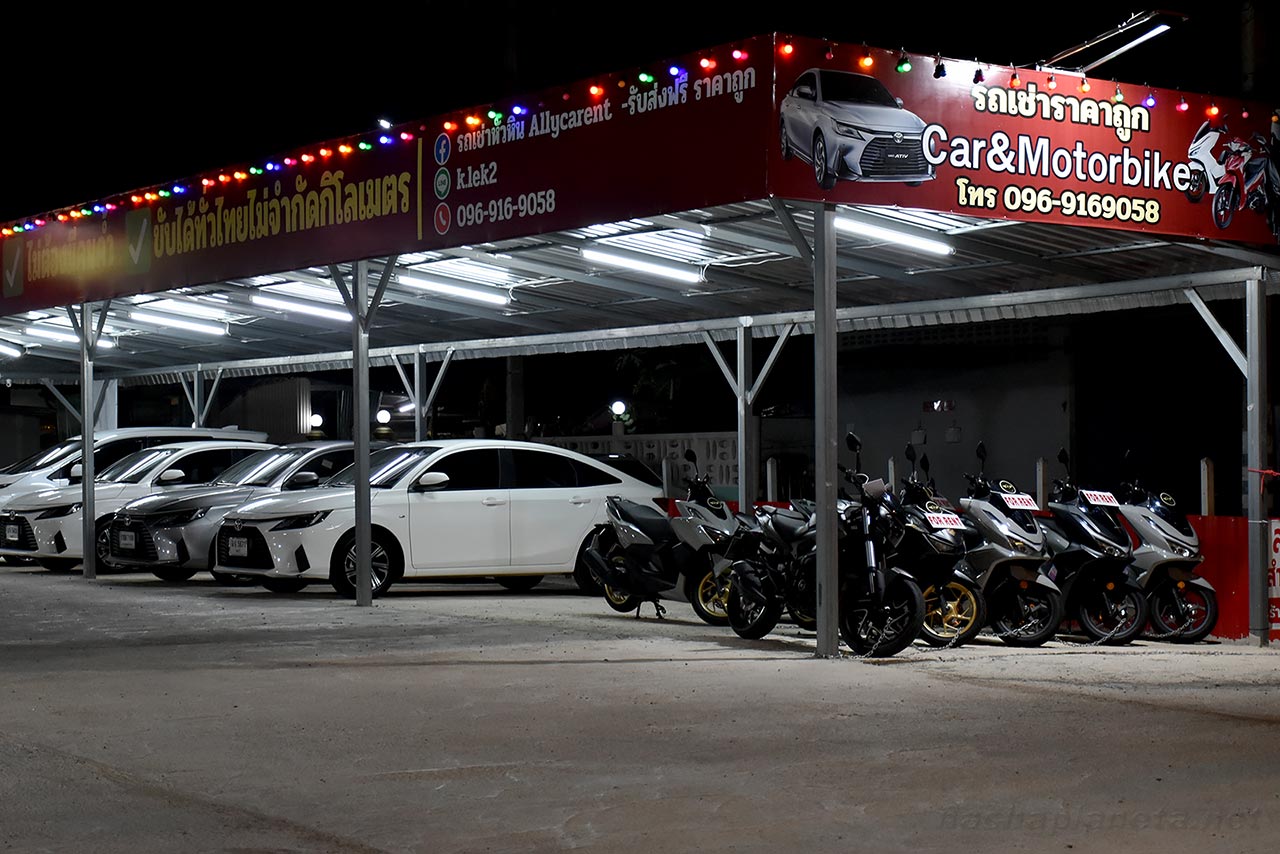
For an action-packed vacation, it's best to rent transport. With your own bike or car, you're not tied to songthaew schedules and don't depend on car availability in the app. You can head to a distant beach, to Cha-Am, to the Pa La-U waterfall, to Khao Sam Roi Yot National Park or a neighboring province, and come back whenever you want.
Motorbike Rental

There are plenty of rental shops in Hua Hin, but not on every corner: in the center they're concentrated around Walking Street and on Naebkehardt Rd, where you can easily find a rental at a suitable price and the right option (old, new, powerful) while out for a stroll. If you're staying far from the center, don't waste time searching on foot: open Google Maps and search Motorbike For Rent, contact the renter via WhatsApp or Line, and arrange delivery right to your hotel. Many renters do this, and it's convenient.
Prices. The minimum price for a motorbike in decent condition starts from 200 baht (5.99 USD) per day when renting for several days. But that's usually a machine that "runs but isn't in its prime." For a new Honda Click or Yamaha Filano, they ask 300-400 baht (8.98-400 USD) per day. For a monthly rental, the price becomes noticeably more favorable, but depends on the season and model. In low season you can realistically find an option for 3,000 baht (89.82 USD) per month, while in high season prices for new bikes reach 4,000 baht.
For details on bike rentals, deposits, and nuances, read our guide to scooter rentals in Thailand.About your passport, license, and insurance. When renting a bike, they most often ask for a photo or copy of your passport. Cash of 1,000-2,000 baht (29.94-59.88 USD) as a deposit is asked for less often. Leaving your original passport isn't recommended. Reputable renters in Hua Hin don't require it.
There's no separate insurance for the bike: all responsibility for the vehicle and the consequences of an accident rests with you. So before renting, it's worth getting travel insurance with an active sports option (which includes riding a motorcycle) and third-party liability coverage. A regular policy without this option doesn't cover riding a bike. Be sure to check the bike before you ride off: brakes, lights, tire pressure. And remember: riding a motorbike without a license or while intoxicated isn't just an accident risk, but also fines. We have separate articles on what license you need in Thailand and what fines are issued for traffic violations here.
Car Rental
Car rentals exist in Hua Hin, but prices here are higher than in Pattaya or at Bangkok airport. If you're planning to do a lot of driving around the area and you specifically need a car, it's sometimes more profitable to rent it in Bangkok and come to Hua Hin by car. That way you don't overpay for local logistics and get more choice. But of course, you need to consider the rental period – if you only need a car for a couple of days, renting it for 10 days at Bangkok airport, while cheaper per day, is still less cost-effective overall. Read all the details in our guide Car Rental in Thailand: What You Need to Know.
In Hua Hin itself, it's best to book online: the city stretches along the coast, and driving around to rental shops looking for a car is not a great activity. Instead, check prices on these comparison sites:
Parking in Hua Hin
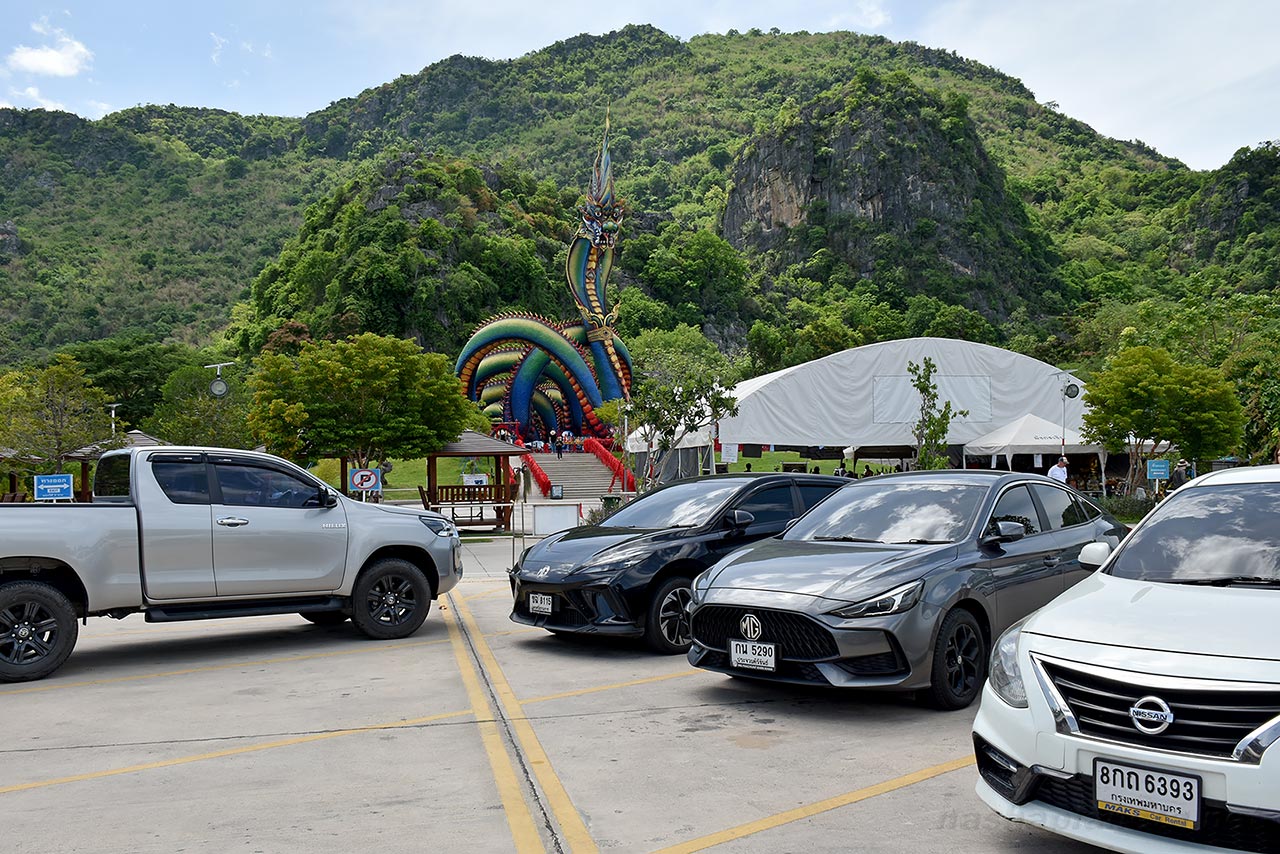
There aren't really any parking problems here: there are enough spaces, and in most cases they're free. Paid parking is available at the Village Hua Hin mall, one of the few places where they charge for parking. Hotels and guesthouses have their own parking for guests, usually free. At beaches and attractions, we never once paid for parking – you can leave a bike or car right nearby.