 Thailand
Video guide to car rental in Thailand
If you'd rather see it once, we've filmed a detailed video guide for you. It covers our real trip from Pattaya to Hua Hin, the refueling process, driving on toll roads, and valuable tips for drivers. Watch it before diving into the article details.
How to rent a car in Thailand: prices, documents (what license you need) and where it's best to book
The rental process in Thailand is simpler than it seems, if you know a few key points. Let's start by breaking it down: what documents you'll need, how much it costs in different regions, and who to rent from safely.
Documents for rental: national license and IDP
Since May 1, 2020, Thailand has ratified the Vienna Convention, and in theory you can drive with a national license. In practice, however, the situation is mixed. Many local rental companies, including those working with Russian-speaking tourists, are happy to give you a car with a Russian license, even stating this on their websites. But on the road, police often ignore this rule and demand an IDP, threatening fines.
Our advice: don't take the risk – get an International Driving Permit in advance (via «Gosuslugi», no medical certificate or exams required) in addition to your Russian license. This will save you nerves and money when dealing with police. For more details, see the article: What license you need in Thailand.

How much does car rental cost in Thailand: prices by class, region, and season
Rental prices aren't fixed. They vary by season, region, and car class. Here are approximate average daily rates for short-term rental (a couple of weeks):
- Small cars (Toyota Yaris, Nissan Almera) – 700–1100 baht (roughly 20.88 – 32.82 USD).
- Sedans, hybrids, and EVs (Honda City, Toyota Vios) – 1000–1400 baht (29.83 – 41.77 USD).
- Compact crossovers (Mitsubishi Xpander) – 1300–1800 baht (38.78 – 53.7 USD).
- Large SUVs and pickup trucks (Toyota Fortuner and similar) – 1800–2500 baht (53.7 – 74.58 USD) and above.
When renting for a full month, local rental companies are happy to offer discounts – the same small car can be negotiated down to 12,000–15,000 baht (358 – 447 USD). When booking through aggregator sites, there's no need to negotiate – the discount is automatically applied based on the rental period.
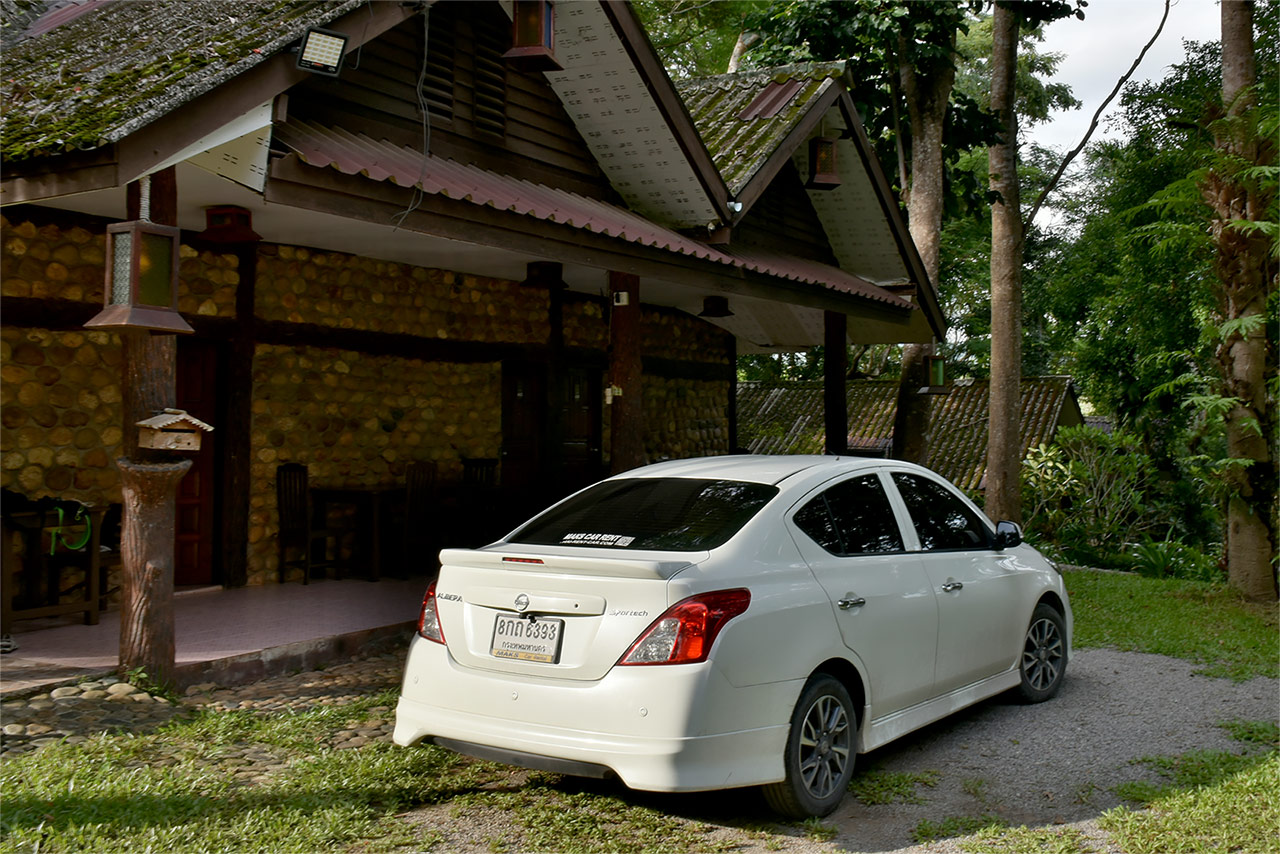
Personal experience: We rented a Nissan Almera for 18 days at 571 baht/day (total 10,278 baht). The car was delivered to our hotel, which was very convenient. The deposit was 5,000 baht. This is a great example of how you can save money on a long-term rental.
Now, about the pitfalls that change these numbers:
- Seasonality. From November to March is peak tourism season. Prices jump by 30–50%, and budget models are snapped up a month before the season starts. In summer and autumn, during the rainy season, prices drop.
- Regions. In Phuket and Pattaya, competition is fierce, so it's easier to find a car and prices are lower. In less popular resorts (Chiang Mai, Hua Hin, Krabi, Kanchanaburi, islands), the selection is smaller and rental is more expensive. So if you're planning to spend your vacation there, it's better to rent a car at Bangkok airport, in Pattaya, or in Phuket, and drive there yourself.
Car rental prices in Phuket vs Pattaya: a comparison
To help you plan your budget, here are current prices (in baht per day) during low and high seasons in 2026:
| Resort | Car class | Low season (May–October) | High season (November–April) |
|---|---|---|---|
| Phuket | Small car (Yaris, March) | 650–900 baht (19.39 – 26.85 USD) | 900–1200 baht (26.85 – 35.8 USD) |
| Sedan (Vios, City) | 900–1200 baht (26.85 – 35.8 USD) | 1200–1600 baht (35.8 – 47.73 USD) | |
| Crossover/SUV (Xpander, Fortuner) | 1400–1800 baht (41.77 – 53.7 USD) | 1900–2500 baht (56.68 – 74.58 USD) | |
| Pattaya | Small car | 600–850 baht (17.9 – 25.36 USD) | 850–1100 baht (25.36 – 32.82 USD) |
| Sedan | 850–1100 baht (25.36 – 32.82 USD) | 1100–1500 baht (32.82 – 44.75 USD) | |
| Crossover/SUV | 1300–1700 baht (38.78 – 50.72 USD) | 1800–2400 baht (53.7 – 71.6 USD) |
Prices are for short-term rental (up to 7 days). For monthly bookings, you can expect a 15–25% discount.
Where to rent a car: options overview and protection from scammers
Before booking, decide two things: where to pick up the car and from whom.
In terms of location, the most convenient option is to order delivery to the airport or rent with free delivery to the rental company's parking lot. The second option is to pick up the car at the resort during your stay. Conveniently, many local companies offer online booking and free delivery of the car to your hotel.
In terms of company types, the market is divided into two large groups:
- International brands (Avis, Hertz, Budget, Sixt). They have counters in the arrivals halls. They have newer cars, transparent contracts, and often offer discounts for early booking. But for Russians, there's a barrier: they require a deposit on a foreign bank credit card. Moreover, many require an embossed card (with raised letters of your name). Cash or Russian bank cards are not accepted. And here's the catch! Not all foreign bank cards that are now offered in Russia with delivery for a fee of 20,000 rubles or more meet these requirements.
- Local Thai and Russian-speaking companies. This is a lifesaver for those who don't have a working foreign card. They accept cash deposits (in baht or dollars), and some accept payment via transfer to a ruble card. Find them through social media, messengers, or local websites.
When working with local companies, follow strict safety rules:
- No blind prepayments or payments via links in messengers.
- Check the office's existence. Find the company on Google Maps, read reviews, look at photos. Be sure to check Street View – is there a sign and a parking lot at that address?
- Verify contacts. Phone numbers and messenger links on the official website or maps should match who you're communicating with. Agree on payment of the main amount and deposit strictly at the time of key handover at the car.
What to know before renting: insurance (1st Class vs Porobo) and step-by-step car pickup checklist
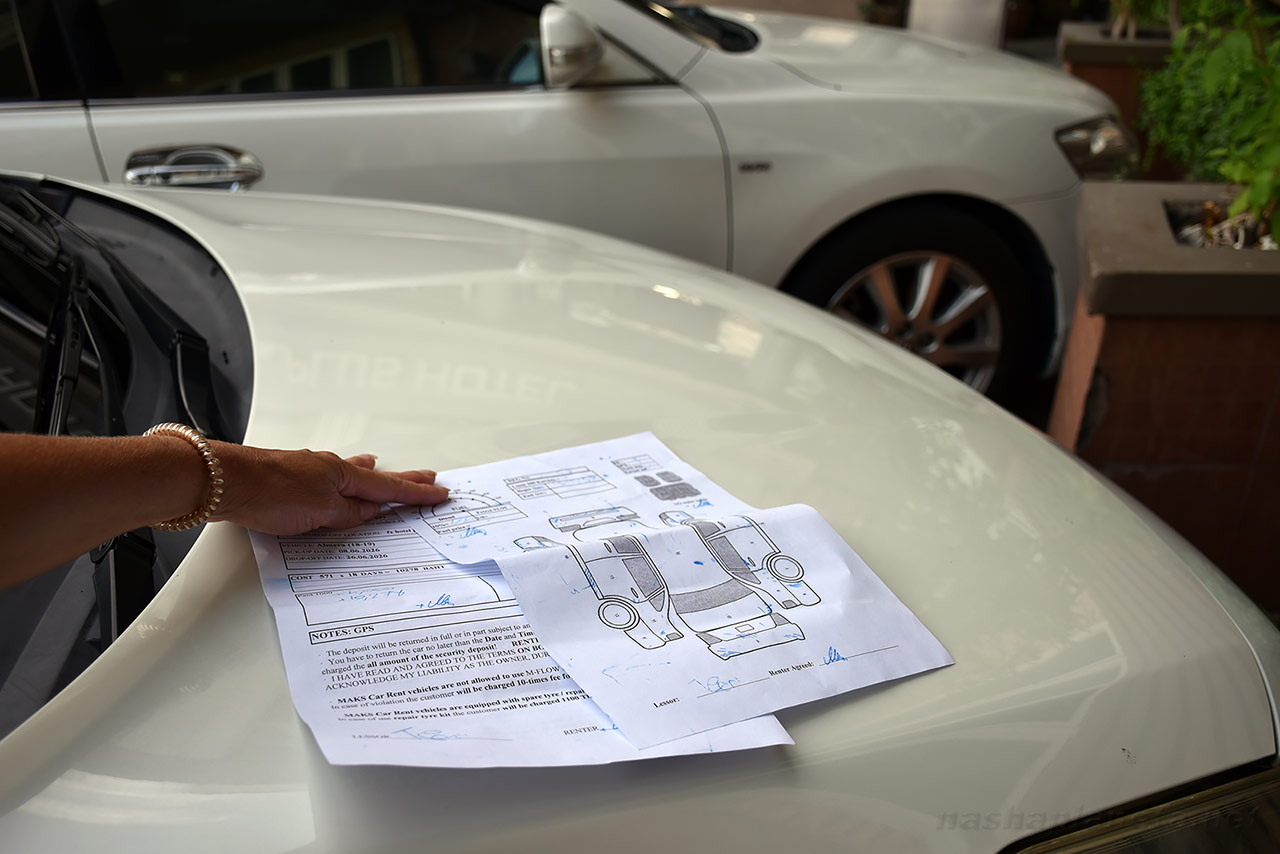
The contract is signed, and you have the keys. But don't rush to drive off – a few extra minutes of inspection and understanding the insurance will save you thousands of baht if something goes wrong. Here are the key safety rules.
Step-by-step car inspection checklist upon pickup
When the car is delivered to you, don't rush to sign the contract. The manager may hurry you, but your task is to document all existing damage.
Turn on your phone's camera, select the highest resolution, and record a continuous 360-degree video walkaround of the car. Record slowly. Make sure the rental employee is in the frame – this confirms the time and place of recording.
Pay special attention to hidden areas:
- The bottom of the front bumper. Look under it – this is the most vulnerable spot, tourists often scrape high Thai curbs.
- Alloy wheels. Photograph each wheel close-up. Scratches on alloy wheels are a favorite reason to keep your deposit.
- Windshield. Check for small stone chips. If a chip turns into a crack during your trip and it's not noted on the form – you'll pay for a windshield replacement.
- Interior and electronics. Start the car, turn on the air conditioning to full. In Thailand's climate, you can't live without it, so it should blow ice-cold air within a couple of minutes. Check the wipers and power windows. If there's a strong smell of cigarettes or stains on the seats – make the manager note it in the protocol. Smoking, transporting animals without permission, or durian in rented cars are subject to fines.
Make sure the employee marks all found defects with X's on the paper diagram of the car in the contract (Car Rental Agreement). Take a photo of this form and keep a paper copy.
Insurance nuances (Porobo vs 1st Class)
In Thailand, it's important to distinguish between two types of vehicle insurance so you're not left without money in an emergency.
-
Porobo (Por Bor Ror) – mandatory government insurance. Its receipt is usually stuck on the windshield. This policy is similar to Russian OSAGO, but it only covers medical expenses for victims in an accident. It will pay for the treatment of the driver, passengers, or pedestrians within limits, but not a single baht for car repairs.
-
Voluntary commercial insurance. For a rented car, 1st Class Insurance is highly recommended. This is a local equivalent of full Casco coverage. Such insurance covers damage to your car, other vehicles, and any affected property, regardless of who's at fault.
However, the terms of this insurance may vary between rental companies, and even for the same car within the same rental company under different rates. Some may include a deductible (the minimum amount you pay out of pocket when an insured event occurs, usually 5,000 baht or more), some may include only theft coverage, while others may cover everything including tire damage. There's no uniform rule, so before renting, find out all the details and read the conditions carefully, weigh the risks based on your experience. Definitely don't take this matter lightly or leave it to chance.
Our experience: The car we rented had 1st Class insurance with a 5,000 baht deductible. This amount was our cash deposit. In case of an accident, we would have lost this money but wouldn't have paid for repairs.
Important! Even the most expensive 1st Class insurance is completely void if:
- You're driving under the influence of alcohol (more than 0.5 promille).
- You don't have a license of the required category or an International Driving Permit.
- You drive on dirt roads if prohibited by the contract.
In addition to car insurance, don't forget to get a travel insurance policy for your trip, and include the necessary options for driving and liability coverage. You can compare and buy travel insurance online on these trusted sites:
What to do in case of an accident or breakdown in a rented car
We hope you'll never need this section. But if trouble happens, it's better to know the procedure in advance.
In case of a traffic accident
- Stop and turn on your hazard lights. Don't leave the scene of the accident – in Thailand, this is a criminal offense.
- Don't panic and don't argue with the other driver. Thais are usually calm, but they may call "helpers" – stay polite.
- Call the police. For tourists, there's a hotline 1155 (English, assistance). Also, 191 works. Explain the situation and your location.
- Take photos and video of:
- The position of the cars on the road (relative to markings, signs, traffic lights).
- All damage up close and from different angles.
- The license plates and the other driver's face.
- Don't sign anything and don't admit fault – even if you think you're wrong. Let the police and insurance sort it out.
- Call the rental company (the number is in the contract). Report the accident. They may ask you to send photos or wait for their representative.
- Don't settle on the spot or hand over money without an official receipt – this is a classic scam.
In case of a car breakdown (not your fault)
- Turn on your hazard lights, put out the warning triangle (should be in the trunk).
- Call the rental company – most have 24/7 technical support. They'll tell you what to do: either send a mechanic, a tow truck, or allow you to go to the nearest tire shop/service center (with subsequent reimbursement).
- Don't repair the car yourself without consulting the rental company – they might not return your deposit.
- If the breakdown is serious (engine failure, transmission, steering stuck), insist on a tow truck. Don't try to tow without experience – in Thailand, it's dangerous.
- Keep all receipts if you pay for repairs or towing yourself.
Important: After any accident or serious breakdown, immediately contact your travel insurance. Many policies cover towing costs, legal assistance, and even compensation for distress. Keep all documents, protocols, and photos.
Thailand traffic rules for tourists: driving features, fines, and pitfalls

Traffic here is left-hand, and that's just the tip of the iceberg. Local drivers live by their own unwritten rules, and road markings and signs can be surprising. Let's break down what to expect behind the wheel.
Speed limits and important Thai traffic rules
Besides the specific "traps," there are standard but extremely important speed limits and requirements that every driver must know:
- Speed limits (for passenger cars):
- In populated areas – no more than 60 km/h.
- Outside cities on regular roads – 90 km/h.
- On toll roads (Motorway) – up to 120 km/h.
- Seat belts – mandatory for the driver and all passengers. Fine for not wearing a seatbelt is 500–1000 baht.
- Child safety seats – under Thai law, children shorter than 135 cm must be transported in special seats or boosters. Absence – fine up to 2000 baht.
- Children in the front seat – prohibited for children under 12 or shorter than 150 cm without a special seat. We strongly recommend always placing a child in the back.
- No phone use while driving – even at traffic lights. Only hands-free devices allowed. Fine up to 4000 baht.
- Warning triangle – mandatory for emergency stops outside populated areas.
- First aid kit and fire extinguisher – formally not mandatory for passenger cars, but we recommend having them (especially a first aid kit).
- Towing – allowed only on a rigid coupling or rope no longer than 4 m. The towed car must have a driver.
- Window tinting – allowed, but the windshield and front side windows must let through at least 70% of light. Too dark – fine and requirement to remove the film.
Test your knowledge! On the website thaidrivingtest.com, you can take a Thai traffic rules test (10 or 50 questions). Note: from Russia, the site may be inaccessible without a VPN.
Local driving specifics: what drivers from Russia need to be ready for
The first hours behind the wheel of a right-hand drive car require maximum concentration. The main difficulty is the dimensions. The left side of the car becomes a huge blind spot. In Russia, we're used to controlling the right side, but here you constantly need to watch the left mirror, because that's where local scooters will squeeze in.
The Thai driving mentality is very different from European or even Russian. There's an unwritten concept of personal responsibility zone: local drivers rarely look around and almost never check blind spots when maneuvering, and it's believed that the driver is only responsible for the space directly in front of the hood. If the car in front of you suddenly changes lanes without a turn signal – you're expected to brake in time, because he doesn't see you.
Another important nuance – headlight signals. In Russia, flashing high beams means "go ahead." In Thailand – the opposite: "I'm going first, give way."
⚠️ Special warning: switching from motorbike to car
Many tourists, having scooter driving experience in Asia, think that switching to a car will be easy. This is a misconception. Driving a car and a motorbike are completely different experiences with different levels of responsibility.
Our experienced motorbike rider, who has ridden tens of thousands of kilometers across Asia, admits that the first two days behind the wheel of a car in Thailand felt like a complete beginner. To the chaotic traffic and left-hand driving, you add the need to get used to an automatic transmission. Your left foot reflexively reaches for the clutch pedal, which isn't there, and instead hits the brake. Assess your abilities soberly and drive especially carefully for the first few days.
Main traffic pitfalls: intersections, U-turns, and parking rules
Here are the main situations where tourist drivers most often make mistakes:
-
Left turn on red. By default, this is allowed in Thailand, but only after a complete stop and yielding to pedestrians and cars on the right. Prohibited if:
- There's a sign saying «TURNING LEFT WAITING LIGHT» or in Thai.
- The traffic light has a separate red left arrow and it's red or not lit.
- The curb at the corner of the intersection is painted with a red-and-white stripe.
-
Extinguished arrow on a traffic light. If the additional section isn't lit at all – you can't go. An extinguished arrow is equivalent to a red light.
-
U-turns. On major highways, the far right lane is designated for U-turns. Be prepared that at speed, you may run into a queue. The radius is often not enough to turn into the far lane of oncoming traffic – you have to go straight into the second lane. The passenger on the left should help monitor oncoming traffic, which is hard to see due to right-hand drive.
-
Equal intersections. There are very few priority signs («Main road») in Thailand. Priority is determined by the presence of a stop line (solid white line) or a «Give way» sign before the intersecting road. If you don't have such signs, but the intersecting road does – you have priority, but local motorbike drivers often fly out without looking. Always slow down before such intersections.
-
Roundabouts. Traffic moves clockwise. Priority goes to those already on the circle, i.e., you must yield to everyone.
-
Where you can't park or stop:
- Closer than 10 meters from any intersection.
- At bus stops (closer than 15 meters to the sign and 3 meters after).
- On pedestrian crossings and closer than 3 meters before them.
- In front of exits from private houses, condominiums, and alleys.
Prohibited road markings: bus lanes, hatched areas, and solid lines
Road markings in the Kingdom have the force of law, and violations are recorded by cameras.
-
Hatched markings («herringbone»). This is a safety zone – driving on it is prohibited. Fine – up to 2000 baht (roughly 59.67 USD). In an accident on such markings, the driver is automatically at fault.
-
Bus lanes. In Bangkok and major cities, the left lane is often reserved for public transport. The asphalt is painted red or green, with a «BUS LANE» inscription and a yellow solid line. Entry is prohibited.
-
Solid lines. Crossing a single or double solid line is prohibited. Exceptions: a major accident, avoiding an obstacle, or a police officer's instruction.
Important trap: Local drivers routinely cross solid lines, and your navigation app may suggest a route that crosses one. However, for a foreigner, this is a guaranteed fine if noticed by police or a camera. Don't copy the locals.
Traffic fines in Thailand: how much and how to pay

For driving without an International Driving Permit or a license of the required category – fine 1000–2000 baht (roughly 29.83 – 59.67 USD).
Other common violations and fines (in baht):
- Running a red light – 1000 baht (roughly 29.83 USD).
- Failing to yield to pedestrians at a crosswalk – 4000 baht (roughly 119 USD).
- Parking in a prohibited place – 500 baht (roughly 14.92 USD) + towing.
- U-turn in a prohibited place – 400 baht (roughly 11.93 USD).
- Driving in the oncoming lane – 200 baht (roughly 5.97 USD).
- Driving without insurance – 600 baht (roughly 17.9 USD).
- Driving under the influence – fine up to 20,000 baht (roughly 597 USD) or up to 1 year in prison. For repeat offense – up to 100,000 baht (roughly 2983 USD). Legal blood alcohol limit: under 24 – 0%, over 24 – 0.05% (≈0.5 promille).
You can pay the fine by:
- Option 1 (illegal but common): Pay the officer on the spot (essentially a bribe). Cheaper and faster, but legally a criminal offense.
- Option 2 (official): Get a receipt and pay it at any Thailand Post office, at 7-Eleven stores (by barcode), at a Krungthai Bank ATM, or online.
Fines from photo and video cameras are sent to the vehicle's registered address (i.e., the rental company). You'll only find out about them when returning the car, and the amount will be deducted from your deposit.
If you want to learn more about all possible fines (including driving without license plates, blocking traffic, motorcycle fines, etc.), read our separate article: Traffic fines in Thailand – complete list.
Toll roads in Thailand: cost, how to pay, savings tips
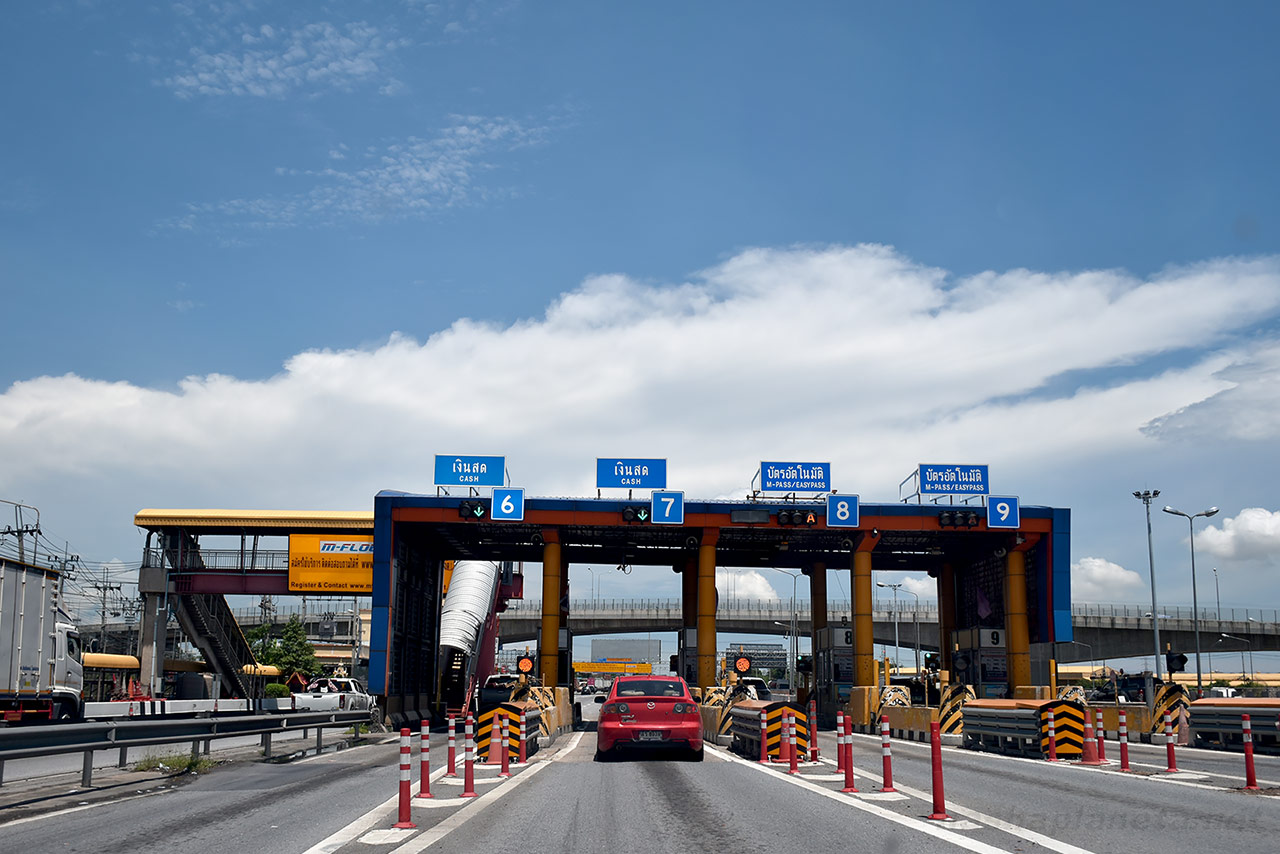
Highways are the best way to travel between regions. Around Bangkok – Expressway, between cities (e.g., to Pattaya) – Motorway. Tolls apply, but we consider these roads worth it. The Bangkok–Pattaya route via Motorway No. 7: perfect surface, no traffic lights, fuel savings offset the toll cost, plus you save time and nerves. The maximum toll on Motorway No. 7 is 120 baht, depending on distance.
Motorbikes, pedestrians, and stopping on the shoulder are prohibited on toll roads. For rest, every 30–50 km there are service areas with gas stations, cafes, and toilets. On holidays (New Year, Songkran), tolls are often waived.
Rules, cost, and payment methods at toll gates
Toll cost – from 30 to 130 baht (roughly 0.89 – 3.88 USD). At the entrance and/or exit depending on the road – toll booths with barriers. You need lanes marked CASH. Pay with paper baht to the operator. Keep small bills (20, 50, 100 baht), change will be given.
At CASH lanes, you can also pay with a physical bank card (including UnionPay from RSHB or ATB), but it doesn't always work everywhere. So always have cash on you just in case.
Other lanes are not suitable for a rented car:
- Easy Pass / M-Pass – for local transponders. If there's no tag on the windshield, the barrier won't open, and you'll create a traffic jam.
- M-Flow – a barrier-free system that reads license plates with cameras. If you drive through without the rental company's consent, they'll receive a fine and deduct it from your deposit at ten times the amount!!!
Important! On many toll sections around Bangkok, payment is collected upon entry (a fixed amount for the entire section). On others, e.g., Motorway No. 7 – upon exit. The main rule: always choose the lane marked CASH, and you'll have no problems – everything is easy to figure out.
Parking in Thailand: overnight parking, parking near beaches and malls, fines
Leaving your car overnight or near a beach in Thailand is an art. The wrong spot will lead to a wheel clamp or towing. Here's where to park safely and cheaply.
Overnight parking: hotels, condominiums, and paid lots
Leaving a car on the side of the road overnight is not safe. The main danger is signs for parking on even/odd days. If you park on the wrong side, you'll find a wheel lock in the morning. Parking must be in the direction of traffic in the left lane – parking against traffic is prohibited.
The safest option is parking at your accommodation. Large hotels have their own free parking. In high-rise hotels in Bangkok, there are multi-level parking garages: you get a ticket at the entrance, which needs to be stamped at the reception before exiting. If you're renting a condo via Airbnb, check with the owner about parking availability in advance.
If a guesthouse doesn't have its own parking, look for guarded night parking lots (Paid Parking / Car Park) – fenced empty lots with a guard. A night costs 100–200 baht (roughly 2.98 – 5.97 USD). Covered mall parking garages don't have overnight rates – you'll be charged a large amount by the hour.
Parking near beaches, attractions, and shopping malls
State parks, viewpoints, and temples always have official parking – free or 20–40 baht (0.6 – 1.19 USD) for the entire time.
Popular beaches have few organized parking lots – cars are parked along the roads. Look at the curb color:
- Red-and-white stripes on the curb – parking and stopping are prohibited. Your wheels will be locked instantly. The same applies to "waffle" (yellow grid) markings on asphalt – crossing or stopping on it is prohibited.
- Yellow-and-white stripes on the curb – no-stopping zone. You can stop for half a minute to drop off passengers, but leaving the car for a long time is not allowed.
- Black-and-white stripes on the curb – parking allowed.
For city walks, it's better to leave your car in a mall's underground parking. The first 2 hours are often free, and the car doesn't overheat in the sun. Near night markets, locals in vests may show you a spot and ask for 50 baht (1.49 USD) – better to pay so the car sits there safely for the evening.
How to refuel in Thailand: fuel types (Gasohol 95, E20, diesel) and step-by-step at gas stations

In remote areas, e.g., in the mountains of northern Thailand, gas stations are rare, and you can run out of fuel. Especially at night. So we recommend filling up the tank to the brim at the first opportunity before driving to such places.
Fuel types: what is Gasohol and which color to choose
There's no pure AI-92 or AI-95 gasoline at Thai gas stations. Instead, there's Gasohol – a mix of gasoline with ethanol from sugarcane. Before refueling, open the fuel cap – there's a sticker on the inside of the cap showing the allowed fuel types.
- Gasohol 95 (orange or green nozzle at the station) – 10% ethanol, 90% gasoline. The most versatile, suitable for any sedan or crossover.
- Gasohol 91 (red) – also 10% ethanol, slightly lower octane. Cheaper, suitable for budget cars.
- Gasohol E20 (light green) – 20% ethanol. Even cheaper, slightly higher consumption. Many modern rental cars are adapted. We were lucky to get a car that runs on E20, and the cost per kilometer was about 2 baht, mostly driving on highways.
- Gasohol E85 (purple) – 85% ethanol. Only for Flex-Fuel engines. Never put this in a regular car – it will ruin the fuel system.
- Diesel (blue) – for pickups and SUVs.
Price hack: Fuel prices in Thailand are market-based and can change daily. For example, over three days, the price of E20 dropped by 2 baht per liter. Watch prices at large PTT stations – they're usually among the lowest.
Step-by-step at the gas station
In Thailand, there's no self-service – you don't even need to get out of the car to refuel. Here's how it works:
- Pull up to the pump, turn off the engine, open the fuel cap from inside.
- Roll down the window and tell the attendant the fuel type and amount. For example: «Gasohol 95, Full Tank» or «Gasohol 95, 500 baht».
- Before the attendant squeezes the trigger, make sure the pump display shows zeros. Sometimes they forget to reset the previous reading.
- Payment is also done without leaving the car – cash or card. Russian UnionPay cards work almost without issues.
Useful tips for drivers in Thailand: what to bring and how to prepare
Here are a few more hacks that will make your trip more comfortable and safer:
- 🎥 Dashcam. The main witness in disputes. Bring one from home (mount, cable, 12V adapter) or buy one here for ~1000 baht (29.83 USD). MicroSD cards are sold at 7-Eleven. Some rental companies, like ours, provide a dashcam for free, but that's more the exception.
- 📱 Navigation and phone holder. Holding your phone while driving is prohibited. Bring a windshield or vent mount. The best navigation app is Google Maps – it accurately shows traffic jams and roadworks. Download offline maps (Organic Maps or Maps.me) as a backup, but remember they don't show traffic.
- 🌐 Internet on the road. Buy a local SIM card or get an eSIM from AIS or TrueMove at the airport or a city office. For how and where to buy a SIM card in Thailand without overspending, read our guide on Thai internet.
- 🔧 Tire repair on the road. If you get a flat tire – don't panic. There are many small workshops along the roads. Look for the sign ปะยาง (Pa yang). A plug repair for 100–150 baht (2.98 – 4.47 USD) takes 10 minutes. Important detail: Some rental companies charge a fine for using the jack and spare tire from the trunk (in our contract, it was 1100 baht). So it's cheaper and easier to drive to a tire repair shop.
- 💦 Wet wipes and air freshener. When you pick up the car, wipe down the steering wheel, dashboard, and handles. This is basic hygiene from personal experience, and an air freshener will help remove unwanted smells.
- 🚿 Before returning the car, wash it and clean the interior, at least superficially. Some rental companies charge a fine for returning a dirty car, and besides, it's generally good etiquette to return a car clean.