Thailand
Do not want to read a lot of text? Here are quick answers on the topic first:
- How much does a tuk-tuk (songthaew) ride cost in Pattaya? – in 2026 the price officially went up from 10 baht to 15 baht.
- How much does a taxi cost in Pattaya? – The minimum price for a car taxi ride is from 60 baht, even for 1 km; in reality it is closer to 100 baht. A trip between districts will cost from 200 baht.
- Do you need a license to rent a motorbike in Pattaya? – Rental shops usually do not ask for documents, but by law you need category "A" and an IDP. Without a license, the fine is 1,000–2,000 baht.
- How much does motorbike rental cost in Pattaya? – A 125cc scooter can be rented from 150 baht per day or from 2,500 baht per month. A new 150cc scooter – from 400 baht per day.
- How to get to Koh Larn from Pattaya? – A ferry runs from Bali Hai Pier for 40 baht (40 minutes). Schedule: departures from Pattaya at 7:00, 10:00, 12:00, 14:00, 15:30, 17:00, 18:30.
- Which taxi apps work in Pattaya? – Grab, Bolt, Maxim, and InDrive work. Uber does not. Grab is the most reliable, Bolt and Maxim are cheaper.
And now let us tell you everything in order from our personal experience:
Most of Pattaya, especially if you are staying in the center, can be explored on foot. The length of the promenade in central Pattaya, where almost all the city's entertainment is concentrated, is just under 3 kilometers.
If you are staying in the north or in Jomtien, want to explore other parts of the city, visit attractions near the city, or are just too lazy to walk, you can use taxis, motorbike taxis, songthaew minibuses, or public transport.
Taxis in Pattaya: prices, apps, and how not to overpay

Taxis and, especially, motorbike taxis are the fastest and most convenient way for tourists to get around the resort and its surroundings, and sometimes the only possible one. However, this is far from the cheap option that bloggers sometimes describe.
Taxi prices in Pattaya
- Minimum price for a car taxi ride – from 100 baht (2.97 USD), even if you only need to go 1 kilometer!
- Ordering a car through an app – from 60 baht (1.78 USD), but prices are dynamic and often higher.
- Getting from one district to another will cost from 200 baht (5.95 USD)
- Getting to one of the attractions nearby, for example Nong Nooch Tropical Garden – 300-400 baht (8.92-11.89 USD)
- A trip to Suvarnabhumi Airport – from 1,200 baht (35.68 USD)
- A motorbike taxi ride – from 30 baht (0.89 USD)
These are the minimum prices, but sometimes you have to pay even more. For example, if you stay until closing at one of the attractions or entertainment venues nearby, it will be very difficult to call a taxi from there through apps or by meter; they may simply not accept your request. Then you will have to choose a higher-priced fare in the app or agree to a ride with a driver in the parking lot at a fixed price instead of the meter. You should be prepared for this, so when planning, allow one and a half to two times more for the return taxi ride.
There are three taxi options in Pattaya:
- Metered taxi (Taxi meter). These are painted cars with checkered markings, easy to recognize. They are everywhere, and you hail and hire them as usual. Just do not forget to remind the driver before the ride to turn on the meter (they are supposed to), and not take you at a fixed price with a surprise at the end of the trip.
- Private taxis (illegal). Private drivers charge negotiated prices, usually cheaper than official ones. But there are very few of them left, and you can accidentally overpay if you do not know the real price. So we advise being careful with them.
- Taxis through apps. These are official taxi drivers, but in most cases in ordinary cars without checkered markings or paint. We use these most often, so we will explain in more detail.
Grab, Bolt, Maxim, and InDrive work in Pattaya. Uber does not. Grab is the most reliable and has the most cars, so requests are accepted quickly. Bolt and Maxim are cheaper. But be careful with Maxim taxis if you need to get to the airport or train station on time, because you can wait up to 30 minutes for a request to be accepted. The InDrive app is good for long trips; you can save money by offering your own price. We personally use all four apps in Thailand depending on the situation and location.
To order a taxi through apps, of course, you need internet. It is best to buy a local SIM card or e-SIM; we explained how to do this without wasting money in this guide: Communications and Internet in Thailand.
If you do not have mobile internet, you can use a one-time WiFi connection in a cafe, hotel, or airport. The ride price is fixed when the request is accepted; you will see it on the screen and pay exactly that to the driver (unless there are extra charges for toll roads), just do not forget this amount when you leave the coverage area.
Payment is in cash at the end of the ride, or you can link a card in the app, but Russian cards do not work.
Tuk-tuks (songthaew) in Pattaya: routes, prices, and how the system works

A whole fleet of songthaew minibuses (Songthaew), sometimes also called tuk-tuks by tourists, circles the streets of Pattaya almost around the clock. This is a very convenient and cheap way to get around the city. The ride costs 15–20 baht (0.45-0.59 USD).
In 2026, for the first time in more than 20 years (at least, that is how long we remember the old prices), the fare for songthaew minibuses or tuk-tuks in Pattaya officially increased from 10 baht to 15, due to the fuel crisis caused by the US war in the Persian Gulf. At the moment the price is flexible: 15 baht for a short ride and 20 for a longer one. Check the "distance" and price with the driver; he will tell you how much to pay when you get out.
In fact, although we said above that they circle "almost around the clock", there is still an important point. Songthaew working hours on fixed routes and at official prices are only during the day. When darkness falls, which is around after 7 pm, they start working as taxis. And during the day, tourists sometimes fall for the old "trick" when they get into a parked tuk-tuk and say which hotel or place they need to go to. Then the driver happily takes the tourists to the right place, but at taxi prices, which is already from 100 baht within one district.
To avoid falling for such tricks, remember these simple rules:
- Do not hesitate to approach the driver before getting in and ask where he is going and the price.
- If possible, ask the driver not for the name of a hotel or specific place, but for the name of the district or street.
- If the minibus is parked and the driver is calling you over, it is usually an offer to ride as a taxi.
How to use songthaews in Pattaya
Pattaya songthaews are not buses but small trucks with an open passenger bed (see photo). They all look exactly like this; there are no others. Inside the covered bed there are two benches for passengers, and payment is made to the driver in the cab through the window when you get out, or in some minibuses through a small window from the bed.
Important! Do not look for real three-wheeled tuk-tuks on the roads of Pattaya, like those in Bangkok or some other cities. There are none here.
Local songthaew minibuses actually have nothing in common with tuk-tuks except for this mistaken nickname that tourists have stuck to them. A real tuk-tuk is a three-wheeled taxi that historically got its name from the rattling two-stroke engines from mopeds. Nowadays this transport has become almost exotic in Bangkok and is usually used for tourist rides rather than getting from point A to point B. Moreover, for tourists, tuk-tuks in Bangkok "charge" more than an air-conditioned taxi.
Inside the bed there is a bell button and a route map with a fare table. True, it is hard to make sense of this map, since everything is either in Thai or simply unclear.
Passengers can get on and off anywhere where stopping is not prohibited by signs. To board, look at the driver of the minibus and wave your hand. To get off, press the bell button inside the bed.
After getting out, go to the driver's window and pay. If you need to pay more (not 15 but 20 baht), the driver will tell you.
All tuk-tuk routes in Pattaya and how to make sense of them

Figuring out how to use tuk-tuks for boarding and payment usually causes no problems even without knowing a foreign language. But when it comes to routes, that is where things get crazy. Unfortunately, it is not all that simple and logical here, but let us try to make sense of it.
In theory, all Pattaya tuk-tuks run on set routes (except when they carry you as a taxi, but we explained that above). There is no numbering on them, and there is an opinion that they differ by color. But here is how things actually are in practice:
- There is no schedule: they go when they want and when they fill up.
- The number on the minibus windshield does not indicate the route. For you, it means nothing at all.
- You cannot determine the direction by the color of the vehicle. There is only one general difference: white minibuses run along Sukhumvit Highway as suburban minibuses, and all other colors run in the city. But even this rule does not always work.
- Although there are well-known established routes (we put them on the map below), they are not always followed at their endpoints. For example, some vehicles on Naklua Road go only to the Dolphin Roundabout and turn back there, while others go further to Beach Road along the beach through the entire central district.
Why does it all work this way? And why not assign at least some numbers to the routes or put route names on the windshield so there is no confusion? Do not ask us; we honestly do not know. But we do know exactly how to use all of this correctly. Here is our algorithm:
- Before your trip, study or refresh your memory of the geography and route scheme from the map below. Download the points from the map to your smartphone using the Organic Maps or Maps.me app.
- Remember two important and most useful transfer points between tuk-tuks:
- Between central Pattaya and Jomtien (terminus on the map).
- Between central Pattaya and the Naklua area, also known as the North or Wongamat (terminus on the map).
- To board the right route, keep in mind that many roads here are one-way, so the routes are circular. You can see the direction of traffic on the desired street on the map if you zoom in.
- Before boarding, do not hesitate to approach the driver and ask if he is going where you need (it is better to name the district, street, or a large shopping mall). You can show the place on the map on your smartphone.
- If in the rush you could not ask the driver before boarding, do not hesitate to ask the local passengers already in the vehicle. If it turns out this is not your route, get out immediately without paying, just wave and smile at the driver; they understand these difficulties.
Tuk-tuk (songthaew) routes on the Pattaya map
On the map below we have marked the exact songthaew routes in different colors. They travel along these streets, but let us remind you that in practice they can go anywhere if you ask the driver, only you will have to pay as for a taxi. You can also open the Pattaya tuk-tuk map on a separate page.
But still, some points about the routes require special comments:
- The most stable routes are the central loop (red), to the Naklua area (blue), and to Jomtien (green). On other routes, songthaews may either run very rarely or not run at all. For example, the route along 3rd Road to Bali Hai Pier, although it exists on maps, does not actually work (verified personally).
- On the central loop route (red line), some minibuses during the day before Walking Street do not turn left but go straight along Walking Street (during the day it is open to traffic) to Bali Hai Pier.
Motorbike rental in Pattaya: prices, licenses, and pitfalls

If you plan to rent a motorbike in Pattaya, first of all we should warn you that traffic in Pattaya is simply insane. And on top of that, traffic in Thailand is left-hand. Devil-may-care bikers zip around on their scooters everywhere, literally millimeters from passing cars, not particularly respecting right of way at intersections, the direction of traffic on one-way roads, and suddenly popping onto the road from sidewalks or alleys. If that has not scared you off, read on.
Motorbikes and scooters can be rented without any problems almost anywhere in Pattaya. Ask at your hotel reception and they will point you to the nearest rental shop, which is probably just a few dozen meters from the hotel. Or just walk down the street and you will find one.
Motorbike rental prices in Pattaya
- Automatic scooter, 125cc – from 150 baht/day (4.46 USD)
- Automatic scooter, 125cc – from 2,500 baht/month (74.34 USD)
- New 150cc scooter at Russian-speaking rental shops – from 400 baht/day (11.89 USD)
- Big bike – up to 1,000 baht/day (29.74 USD)
If you rent for several days, they give a discount. Monthly rental is sometimes more profitable than, say, for 20 days. But all this is discussed on the spot with the rental shop: ask, calculate, and make a decision.
License, insurance, and contract: what to know before renting
They almost never ask for a license when renting scooters, so it is quite possible to rent without one. But you should have one on the road, and it must be category "A". Police really do stop tourists on bikes, and very often. The fine on the spot is 1,000–2,000 baht. Other fines for reference here.
Whether tourists need an IDP is a debatable question. On the one hand, Thailand signed the Vienna Convention on Road Traffic and undertakes to recognize IDPs. On the other hand, in practice fines are issued. In our experience, we have shown local police only our national license (while having an IDP), and sometimes it worked, but more often they demand to see the IDP and do not accept the national one. So our recommendation remains the same: it is better to get an IDP at home and ride calmly and without conflicts with police on the road. By the way, note: you cannot always pass off some fake translations or forgeries from local stalls as Russian or other IDPs; the police even have samples. More details about licenses in Thailand, how and where to get an IDP.
There is no single practice for rental deposits in Thailand. Some places ask you to leave your passport (which is very dangerous), some ask for a cash deposit and take photos of your license and passport, and some simply ask you to show your hotel key and its name. But in Pattaya they are strict about this, primarily because of dishonest tourists, so it is difficult to get a bike without leaving a document as a deposit. As an option, you can leave your old or second passport, or your internal ID.
A simple written contract is signed for the rental, practically "on the knee". Nevertheless, we advise you to treat it carefully so that it states the amount, terms, and phone numbers.
And here are more tips:
- Photograph and make a video of all damage.
- Ride only in a helmet. Without a helmet you will instantly attract police attention and 100% get a fine.
- Park carefully, watch for no-parking signs and markings (red-white and yellow-white markings on the curb, zebra crossings on the asphalt). The fine for parking in the wrong place is 500 baht, and a blocking chain is put on the motorbike.
- Near attractions there are free parking lots or paid ones from 20 baht.
- At night it is better to park in safe places at the hotel parking lot under a camera. There are paid night parking lots for 30–50 baht.
- As a rule, there is no insurance on the motorbike, so you cover all damage yourself.
- Standard travel insurance or the cheapest separately purchased policy does not cover damage and injuries on a motorbike. Get a policy with an active sports option.
This is only the most basic thing you need to know. If you have never rented a motorbike in Thailand before, we advise reading our detailed guide with video: motorbike rental in Thailand – everything you need to know. And if you have never ridden such a vehicle at all, watch this topical video:
Car rental in Pattaya
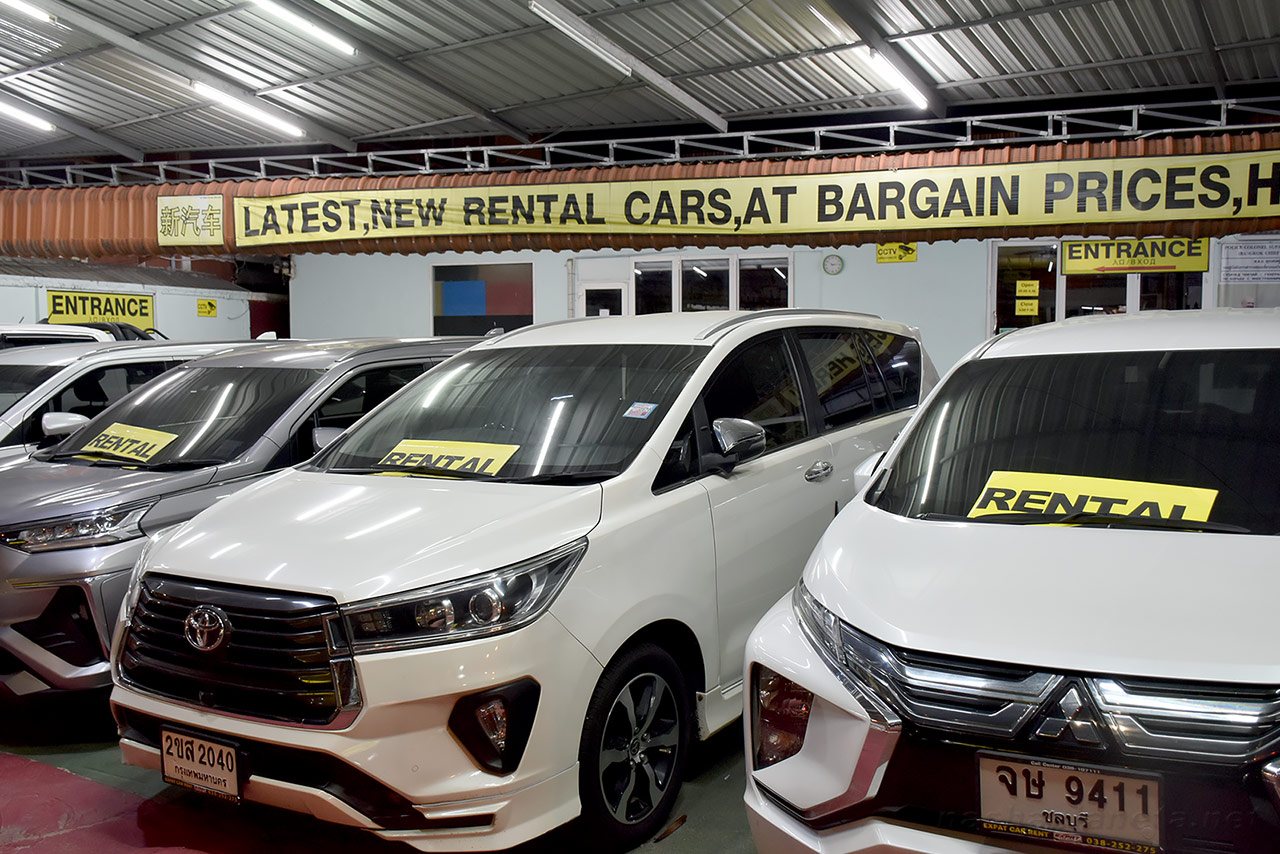
Car rental in Pattaya is also very common and affordable. What is nice is that car prices in Pattaya are among the lowest, so it is also a great starting point to take a car and head from here to other regions.
- Small car for a few days – from 600 baht (17.84 USD)
- Small car for a long term – from 400 baht (11.89 USD)
- SUV or crossover – from 1,000 baht (29.74 USD)
As for traffic, licenses, and rental conditions, we have basically covered everything above. As for the deposit, large international rental companies traditionally require a credit (not debit) card, and an embossed one (personalized with raised letters). Of course, Russian cards do not work for this.
But there are options for tourists from Russia. Quite a few local rental shops accept a cash deposit of 5,000–10,000 baht. In addition, in reviews we have even seen information that some people managed to use a UnionPay card from Russian banks for the deposit, but we personally cannot confirm this.
If you decide to rent a car, below is a list of international companies and aggregators for online booking. And if those do not work out, look for rentals on the spot or arrange booking directly through messengers using contacts from search, or look on Google Maps.
We also have a full guide with video: car rental in Thailand: a complete guide to prices, licenses, traffic rules, and life hacks. If you have never rented a car before, we strongly advise studying it in detail.
Bicycle rental in Pattaya
If you do not have a license or do not want to risk the complexities of local traffic, you can rent a bicycle, scooter, or electric scooter in Pattaya. But finding their rental shops is harder than a motorbike or even a car, and the prices are almost the same as for a low-powered petrol scooter. Before deciding on a bicycle ride, we advise taking a closer look at the streets and realistically assessing the traffic, how busy the sidewalks are, and of course the local heat. In any case, we do not advise riding a bicycle on the roadway; it could end tragically.
If you have firmly decided to rent a bicycle, the easiest way to find the nearest rental shop is on Google Maps by searching for bicycle rental.
The prices are approximately: 3 hours – 150 baht, one day – 250 baht. Renting an electric scooter or e-bike from 400 baht/day. Yes, do not be surprised, motorbikes can be found even cheaper than a bicycle; this is not a mistake. You can rent for a month for 3,000 baht, so if you are here for a long time, it will be cheaper to buy one.
Ferries

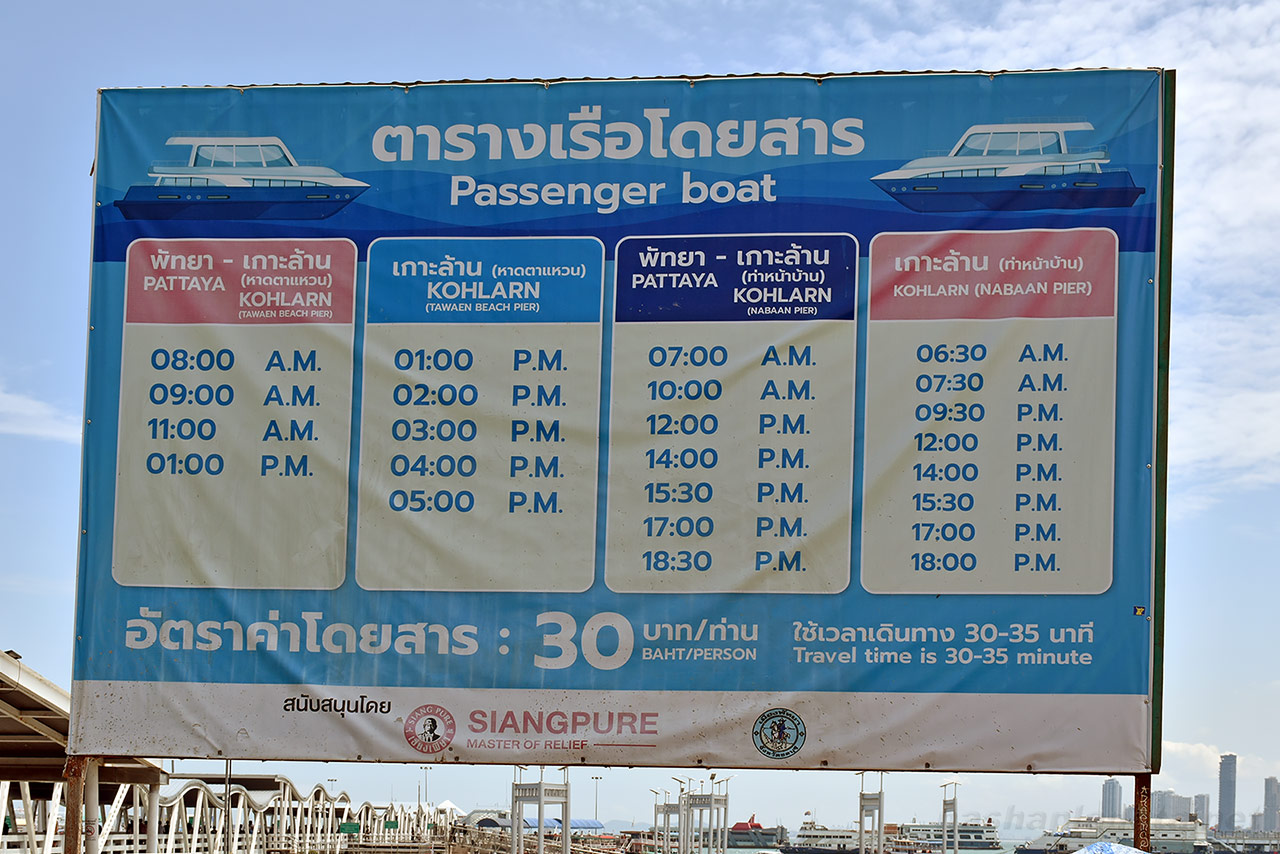
The only regular ferry runs from Bali Hai Pier in central Pattaya (Bali Hai Pier on the map) to Koh Larn island. This island is very popular with tourists and locals as a weekend getaway and for a day trip to the best beaches near Pattaya. The ferry runs on schedule:
| Pattaya → Koh Larn (Thawaen Pier) |
Koh Larn → Pattaya (Thawaen Pier) |
Pattaya → Koh Larn (Na Ban Pier) |
Koh Larn → Pattaya (Na Ban Pier) |
|---|---|---|---|
| 08:00 | 13:00 | 07:00 | 06:30 |
| 09:00 | 14:00 | 10:00 | 07:30 |
| 11:00 | 15:00 | 12:00 | 09:30 |
| 13:00 | 16:00 | 14:00 | 12:00 |
| 17:00 | 15:30 | 14:00 | |
| 17:00 | 15:30 | ||
| 18:30 | 17:00 | ||
| 18:00 |
Overall, this schedule has been unchanged for many years, but sometimes ferries may actually depart earlier if they fill up with passengers, so it is better to arrive at the pier early, at least half an hour before, and even better an hour before.
The fare is 40 baht (1.19 USD), and the journey takes 40 minutes. The boat rocks quite a bit, and if you are prone to seasickness, take a motion sickness pill in advance just in case.
Besides the slow ferry, from the same pier and from the beaches there are speedboats for 150–300 baht/person, which get you to the island in 15–20 minutes, but they run without a schedule and only when they have enough passengers.