 Thailand
Description of the Chinatown Area and What's Interesting for Tourists

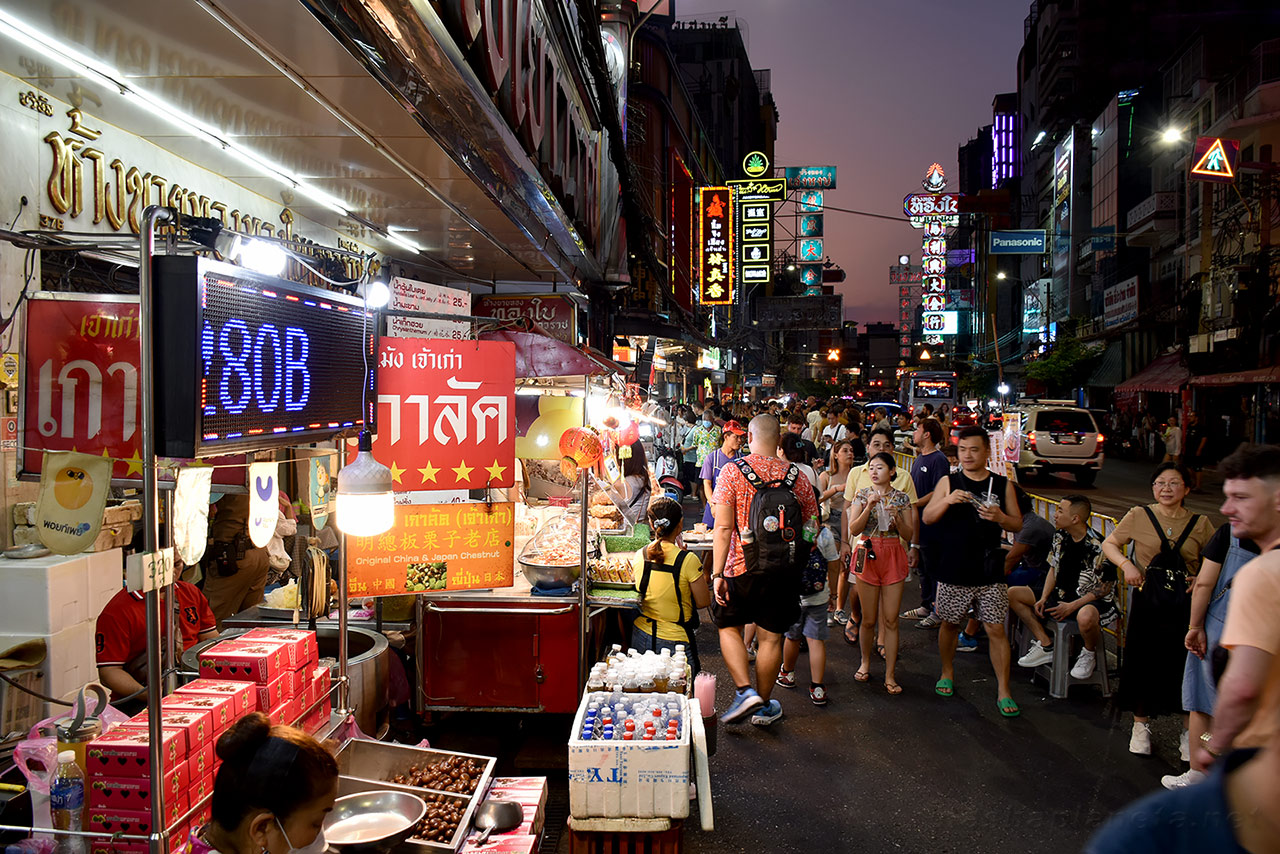
Chinatown is one of the districts of Bangkok interesting for tourists in the historic part of the city on Rattanakosin Island, alongside the popular tourist district Khao San Road (Chinatown on the map). However, compared to the Khao San area, there are very few hotels here, and almost no travel agencies or other tourist infrastructure. But if you stay here, you'll be living in perhaps the most colorful and interesting place in the city, which has preserved the hustle, crampedness and deeply rooted traditions inherent in any traditional Chinatown.
You can't say it's a very cozy and spacious district for tourists: one wide street, Yaowarat Road, runs through it, and all the other streets, as befits a real Chinese quarter, are either very narrow or so packed with stalls and workshops that you can't walk or drive through them. Some streets are occupied by craftsmen and artisans who are constantly fixing or creating something, while some are entirely commercial. The main shopping street is Sampeng Lane, running parallel to Yaowarat Road. You won't buy anything special here, just ordinary Chinese cheap goods, but the prices are very low. On the main street there are several jewelry workshops with currency exchange offices with a very good rate, perhaps the best in Bangkok.
Chinatown has several interesting Bangkok temples: the Temple of the Golden Buddha, the Crocodile Temple Wat Chakrawatrachawat Woramahawihan, and the most important and largest Chinese temple Wat Mangkon Kamalawat (Wat Leng Noei Yi).
And this area is also visited as an attraction or entertainment in the evenings to try exotic Chinese cuisine. With the onset of darkness, countless food stalls and mobile kitchens spring up like mushrooms after rain on the sidewalks along the main street Yaowarat Road and in the neighboring alleys, and the sidewalks are filled with tables and chairs. Mostly Chinese food is cooked here, but overall you can try dishes from any Asian country.
If you're not sure you'll like this district, read our guides to other Bangkok districts:


There are very few hotels in the Chinese district, mostly concentrated near the Hualamphong railway station (Hua Lamphong). And honestly, there's not much point in staying in Chinatown, the tourist infrastructure here is too poorly developed, i.e. there are practically no travel agencies, no tourist transfers offered on every corner, and the like.
Nevertheless, if you really need to, you can book hotels in Chinatown on these trusted sites:
- 🛌 Search hotels in Bangkok on Trip.com (👍 work with MIR cards)
- 🛌 Hotels in Bangkok on Yandex.travel
- 🛌 Search hotels on Ostrovok.ru
Chinatown Area Map with Attractions, Hotels, Transport
How to Get to the Chinatown Area
Chinatown is home to Bangkok's former main railway station, Hua Lamphong, and the MRT subway station of the same name is there too. They're not in the center of this district, but it's not hard to walk there. And the Hua Lamphong metro station, in turn, can be reached directly or with transfers from anywhere in Bangkok that has subway or skytrain, as well as from Suvarnabhumi Airport by airport rail link with a transfer at Makkasan / Phetchaburi station.
On commuter boats along the Chao Phraya River you can get to Rajchawongse or Marine Depot pier, and then 10 minutes to Yaowarat Road.
From Don Mueang Airport you can get to the district by city buses 4, 27, 78, 108. Buses depart from the bus stop on the main road near the terminal. After exiting the terminal, you need to walk a bit to the left following the signs, the stop is on the road on the airport side. The trip, depending on traffic, takes from one and a half to two and a half hours.
Another option from Don Mueang is by train. Directly opposite the terminal, via an elevated walkway, is Don Muang Railway Station, from where at least 30 trains a day depart to central Bangkok to the main Hualamphong railway station, including overnight services. The trip takes a little less than an hour, and costs only 5 baht. Train schedules are here – railway.co.th, and more details on how to get from Don Mueang Airport to Bangkok by train here.
If you decide to get to Chinatown by taxi, then it's important to use metered rides, not fixed prices. Even better to use the Grab app, since then you'll see the cost of the trip right when ordering, and avoid possible surprises with rigged meters, double tariffs for night rides, etc. However, keep in mind that for toll roads you'll have to pay extra on top of the meter or the Grab-calculated amount. For reference, the cost of a taxi ride to the Chinatown area:
- From Suvarnabhumi Airport – from 400 baht (4.49 USD)
- From Don Mueang Airport – from 450 baht (4.49 USD)
- From the Pratunam district – from 130 baht (4.49 USD)
- From the Khao San area – from 100 baht (4.49 USD)
If you want a car to be waiting for you on arrival at the airport and a driver to meet you with a sign, you can order a ready-made tourist transfer to any place in Bangkok via the search form:
What to See in the Chinatown Area
Chinatown itself is a very colorful district and an attraction in itself. It's worth coming here and wandering through its narrow winding streets, observing the life of the Chinese community, shopping at the endless street markets, and in the evening throwing a feast for the stomach at the exotic street food courts. Besides that, the area has several interesting temples worth visiting:
-
Temple of the Golden Buddha (Wat Trai Mit)

Temple of the Golden Buddha This unremarkable temple could have been just one of a thousand temples if it weren't for the world's largest golden statue of a seated Buddha. Thais say it's made entirely of gold, but no one has verified that. The statue weighs 5.5 tons and is over 3 meters tall. Buddha's pupils are black Thai sapphires, and the whites of the eyes are made of pearl. It's about 700 years old.
The complex consists of several temple buildings and even a museum, plus two more temples nearby: the Golden Dragon and the Lotus Temple. The museum has two floors and is dedicated to the history of the statue, while the lower floor tells the history of Bangkok's Chinatown, where the temple is located. More about the Temple of the Golden Buddha.
🕐 Opening hours: daily from 9:00 AM to 5:00 PM.
💵 Entrance fee / ticket prices: entrance to the temple with the Golden Buddha (4th floor) - 40 baht, entrance to the museum (2nd and 3rd floors) - 100 baht (2.99 USD).
🚶 How to get there: the temple is in the Chinatown area (Temple of the Golden Buddha on the map). The easiest way to get here is by Bangkok MRT subway to MRT Hualamphong station (Bangkok's Hualamphong railway station is also here), then a 5-minute walk.
-
Crocodile Temple Wat Chakrawatrachawat Woramahawihan

Crocodile Temple Wat Chakrawatrachawat Woramahawihan in Bangkok Wat Chakrawatrachawat Woramahawihan, also Wat Sam Pleum or simply Crocodile Temple, is one of the capital's most unusual temples. It doesn't shine with beauty or architecture, and is generally little known, but as is clear from the name, it's home to crocodiles – real, live ones. There are 4 reptiles living here, and every day around 5:00 PM the monks feed them. To be fair, besides the crocodiles there's plenty to see here, and it's also one of the capital's oldest temples. More about the Crocodile Temple.
🕐 Opening hours: from 8:00 AM to 4:00 PM, no days off.
💵 Entrance fee / ticket prices: free.
🚶 How to get there: the crocodile temple is in Chinatown (temple on the map), and finding it on your own isn't so easy. The dense buildings and narrow streets of the Chinese quarter hide the temple until the very last moment, until you walk through its gates.
-
Chinese temple Wat Mangkon Kamalawat

Chinese temple Wat Mangkon Kamalawat in Bangkok Wat Mangkon Kamalawat (also Wat Leng Noei Yi) is the largest and most important temple of Bangkok's Chinese community, which follows the Mahayana Buddhist branch. It was built in the early 19th century in a classic Chinese architectural style.
During religious and other holidays, colorful festivals are held here. It's not worth going here specifically to visit this temple, but if you're strolling through Chinatown, be sure to stop by, it'll be interesting. You can freely and without restrictions walk around the temple and enter any rooms. More about the Chinese temple.
🕐 Opening hours: from 8:00 AM to 4:00 PM, no days off.
💵 Entrance fee / ticket prices: free.
🚶 How to get there: the temple is among the dense buildings of the Chinese quarter, and it's best to look for it with a navigator (temple on the map). The entrance to the temple is from Charoeng Krung road.
-
Wat Liap Temple

Wat Liap Temple Wat Ratchaburana Ratchaworawiharn or Wat Liap is a fairly large temple complex in central Bangkok near the Chinese district (Chinatown) and the flower market. It doesn't stand out for anything special except for an unusual green stupa in the Khmer architectural style, i.e. shaped like a corn cob. Another notable feature is the interior murals by a monk and talented artist named Krua In Khong.
The temple was built by an influential Chinese merchant in 1793 with the approval of King Rama I to store 162 important Buddha statues. During World War II the temple was almost completely destroyed and even removed from the list of official royal temples, but in 1960 it was restored again. More about Wat Liap Temple.
🕐 Opening hours: during the daytime.
💵 Entrance fee / ticket prices: free.
🚶 How to get there: the temple is in central Bangkok (temple on the map). You can get here by taxi, bus, or boat on the Chao Phraya River to Memorial Bridge pier, or take the MRT subway to the nearest new Sanam Chai station, and from there a 20-minute walk.
-
Flower Market (Pak Khlong Talat)

Flower market This is the largest flower market in Thailand. The stalls here are piled with the roses, lilies, chrysanthemums we're used to, exotic orchids and other unfamiliar flowers. Under the same roof there's also a vegetable market.
You can't say this place is a must-visit, but if you've already seen everything in Bangkok or want something unusual, it's worth stopping by. More about the Bangkok flower market.
🕐 Opening hours: around the clock.
💵 Entrance fee / ticket prices: free.
🚶 How to get there: the market is on the banks of the Chao Phraya River on the edge of Bangkok's Chinatown (market on the map). Without a taxi you can only get here by city buses or boats on the Chao Phraya River. You need to take orange line boats or boats without a flag to Yodpiman Pier. Also, recently you can get here by MRT subway to the new Sanam Chai station and walk a bit. A trip to the market from the tourist Khao San Road area will cost about 50-80 baht..
-
Yodpiman River Walk Waterfront

Yodpiman waterfront Yodpiman River walk is a small tourist recreation area, something like a pedestrian street or waterfront with a couple of restaurants and cafes, and an excellent view of the Chao Phraya River. It's little known, and you rarely see foreigners here, but if you really have nothing to do in Bangkok, you can stop by and have dinner in one of the restaurants overlooking the boats sailing along the river and the other bank lit up with lights. There are probably no other such quiet and romantic places in Bangkok. More about the Yodpiman waterfront.
🕐 Opening hours: around the clock, best visited in the evening. Attention! as of 2026 the waterfront is temporarily closed for repairs.
💵 Entrance fee / ticket prices: free.
🚶 How to get there: the Yodpiman waterfront is on the banks of the Chao Phraya River in the Chinatown area (waterfront on the map). The easiest way to get here is by commuter boat on the Chao Phraya River to Yodpiman pier (boats without a flag), or to Memorial Bridge and Rajinee (on boats with an orange flag), and a 5-minute walk. However, keep in mind that boats only run until 7:00 PM, after which you can only leave here by taxi. Also, recently you can get here by subway to the new Sanam Chai station and walk a bit.