What Is a "Century Egg" and Why Is It Called That
Let's start with the main thing: a century egg isn't stored for a hundred years. Or even ten. The process takes from several weeks to several months – usually 1 to 3 months. The name is more marketing than reality.
The technology is simple and simultaneously wild: the egg (usually duck, less often chicken or quail) is preserved without air access in a mixture of clay, ash, salt, lime, and tea. In this alkaline environment, the white transforms into a firm dark jelly, and the yolk becomes creamy, gray-green, or dark blue. Sometimes beautiful white patterns appear on the surface, resembling pine branches. Beautiful, if you don't know it's an egg.
The history of this delicacy dates back to the Ming Dynasty, about 600 years ago. According to legend, a Chinese man from Hunan province found eggs in slaked lime he was using to build his house. He decided to try them – and didn't get poisoned. And that's how the recipe was born.
What It Looks Like and Smells Like (Spoiler: Not for the Faint of Heart)
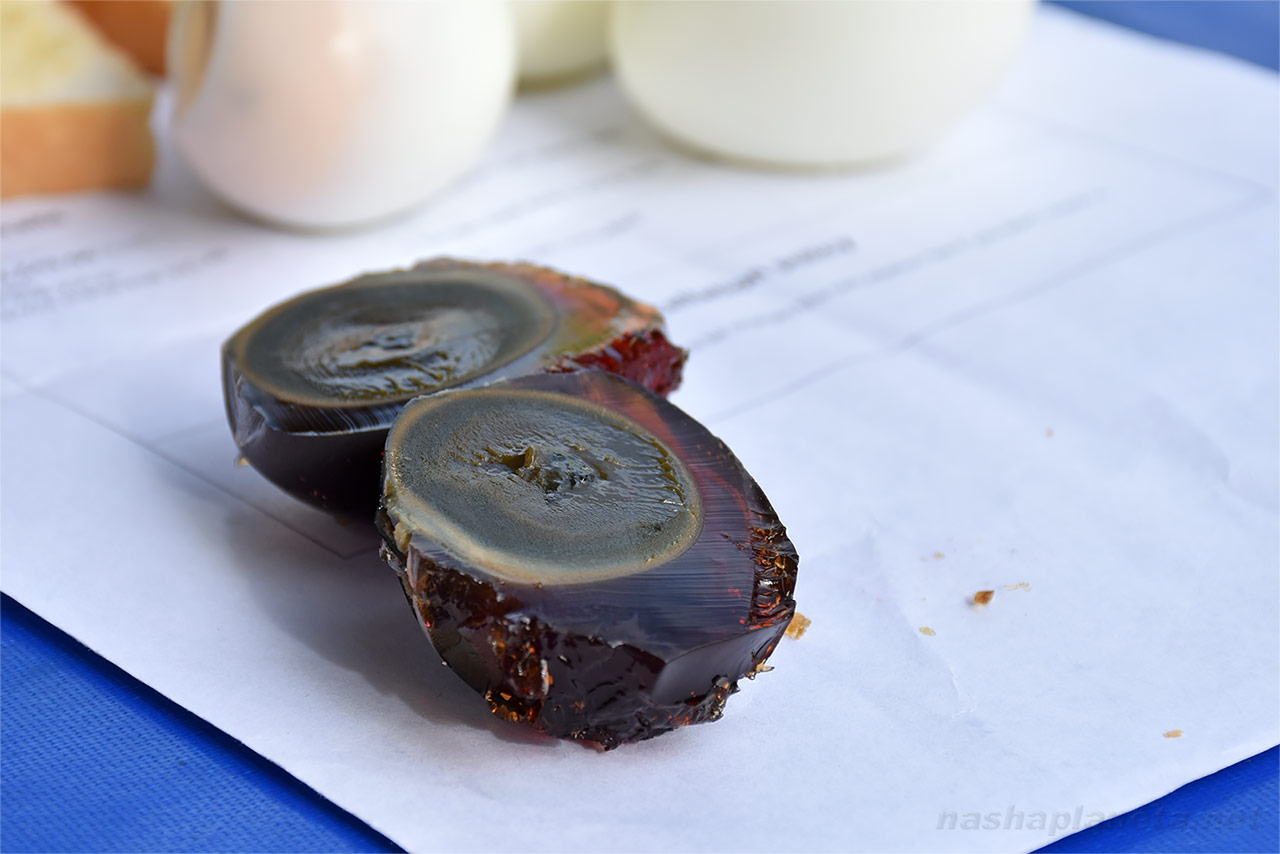
When we peeled the egg, the first thing we saw was a dark, almost black jelly with a glossy surface. It looked like a piece of onyx or amber. Translucent, firm. Beautiful, honestly. But then we smelled it.
The smell – ammonia. Strong, sharp, reminiscent of spirits of ammonia. In the background – sulfur, but that's present in any egg. We had three people smell it – the verdict was unanimous: it smells like acetone. But as connoisseurs say, that's normal.
We cut it open. The white – dark, firm, like marmalade. The yolk – creamy, oily, dark green. It doesn't look appetizing, but that's the whole point.
And the Taste? We Tried It So You Don't Have to Wonder
The most important question. We took a bite. And you know what?
The white is almost tasteless. Slightly salty, jelly-like. But the yolk is a completely different story. It's creamy, oily, with a rich, slightly salty flavor. Something between pâté, aged blue cheese, and mushroom broth. The texture is like very soft cheese. The taste is complex, deep. We found it quite edible. Even with beer.
One of us compared it to balut (a Filipino delicacy with an embryo). The difference is huge: balut is a test for your stomach and psyche. But pidan – it's just unusual. Not scary, not disgusting. Just strange.
Want to see our live reaction? Watch the video above – there we peel, smell, and taste these unusual eggs. Spoiler: no one ran away.
Tip: if you're trying pidan for the first time, don't eat it alone like we did. Better add soy sauce, sesame oil, or ginger – they soften the strong smell and make the taste more familiar.
Why Do Chinese People Eat This? Health Benefits, Myths, and "Male Strength"
Of course, not just for the exotic factor. Pidan has a reputation as a healthy product.
What the facts say:
- The proteins are broken down into amino acids during fermentation – they're easier to absorb than in regular eggs.
- The level of harmful cholesterol in the yolk is reduced.
- The product is rich in iron, calcium, phosphorus, potassium, and selenium.
- In Chinese medicine, it's believed that pidan stimulates gastric juice production and improves appetite.
What the legends say: it's credited with properties for "male strength." We didn't test it, but in China they believe in it.
What the skeptics (us) say: we think believing in legends or not is up to you. But if an egg helps with colds or blood pressure – why not.
How to Eat Pidan Properly So You Don't Regret It
We ate it straight, raw. But experienced people advise:
- Slice it and serve as a cold appetizer.
- Drizzle with soy sauce, sesame oil, add ginger or vinegar – this removes the strong smell.
- Add to rice porridge – where it reveals itself especially softly.
We tried it plain. Honestly, it would have been better with sauce. But even without it – it's tolerable.
Where to Buy and How Much It Costs
We found them in Thailand, at a Lotus's supermarket. Four eggs for 49 baht – about 1.46 rubles. Cheap for such an exotic experience.
In China, they're sold everywhere. In Russia – in specialized Asian stores or on marketplaces. Search for: "pidan," "century egg," "thousand-year egg."
Is It Worth Trying? Our Honest Answer
If you love experiments and aren't afraid of strange smells – yes. It's safe, interesting, and gives you plenty to talk about. If you're afraid of ammonia and dark-colored food – pass.
We tried it. Didn't regret it. But we probably won't buy it again. For the experience – it's worth it. For dinner – no.
Would you dare to try it? If you enjoyed this experiment, you might be interested in our big guide to Thai cuisine for beginners – there we tell you what else to try in Thailand without risking your stomach.