What a Newbie Needs to Know About Thai Food
Thailand is a paradise for food lovers. But if it's your first time here, the local cuisine might surprise you. The biggest surprise is the spiciness. What a Thai person considers "just a little spicy" can be a real test of endurance for a European. So remember the most important phrase: "No spicy" or "Little spicy". And don't be shy to repeat it. Even if you order "no spicy," be prepared that there might still be some heat – that's the Thai mentality. Just accept it and ask for water.
The second important point: Thais aren't wrong in considering their cuisine one of the best in the world. The basic principle is the balance of five flavors: sweet, salty, sour, bitter, and spicy. One dish can have all of them at once, and it works. We think you get used to it in just a couple of days, and then European food starts to taste bland.

How to Order and Not Mess Up
- Rice is the foundation. Thais eat rice from morning till night. In Thai, "to eat" literally means "to eat rice." If you order a main dish, rice often comes separately and you need to order it additionally. That's normal.
- Don't be afraid of street stalls. Thailand doesn't have health inspections as we know them, but street food is sacred. Watch the flow of people: if locals are crowding around, it means it's tasty and safe here. If the stall is empty – better walk past.
- Fish sauce is a friend, not an enemy. The smell you smell on the street isn't spoiled food, but fermented fish sauce (nam pla). It's the Asian equivalent of salt, giving dishes depth of flavor. You get used to it quickly.
Life hack: If the menu doesn't have an English translation, just point your finger at the plate of the Thai person next to you and say "same same." They'll understand and bring you the same thing. This works without fail.
What and Where to Eat: A Guide to Dishes and Places
Top 5 Dishes for Your First Encounter
Don't try to cover everything at once. Start with these five items – they'll give you a taste of the cuisine and definitely won't disappoint.
- Pad Thai. Fried rice noodles with egg, shrimp or chicken, bean sprouts, and peanuts. Sweet and salty with a hint of lime sourness. The most popular street dish. In Thai, it's like "Thai-style spaghetti." Perfect for a newbie – not spicy, filling, and delicious. Price on the street – 50–80 baht.
- Tom Kha Kai. A creamy, mild coconut milk soup with chicken, mushrooms, and galangal root. If Tom Yum is a brain explosion, then Tom Kha is a soothing bath. Hardly spicy at all, but incredibly fragrant. It's a lifesaver when your stomach is tired of spicy food.
- Khao Pad. Fried rice with egg and meat. The simplest and most filling lunch. Served with a slice of lime and cucumber. For 50–70 baht, you get a proper meal.
- Som Tam. Green papaya salad. Spicy-spicy-spicy. It's made with garlic, chili peppers, tomatoes, and peanuts. This is a case where you need to say "no spicy," otherwise you won't taste the papaya behind all the heat. Costs 60–80 baht.
- Mango Sticky Rice. A dessert you'll remember for the rest of your life. Ripe mango + sticky rice + coconut milk. Sweet, delicate, perfect. Eat it fresh, just made. Price – 50–80 baht per serving.

Street or Restaurant: What to Choose
Street food in Thailand is in no way inferior to restaurant food, and often surpasses it in freshness. At street stalls, they cook in front of you – you see how they chop vegetables and toss them into the wok. In a restaurant, you don't know how long the pre-prepared ingredients have been sitting in the fridge.
- Choose the street if: you want to experience the real Thailand, save money, and try authentic dishes.
- Choose a restaurant if: you need air conditioning, a menu in your language, and a chance to relax.
For the first introduction to the cuisine, many choose a restaurant – it's easier to get familiar with the menu and ordering process. But if you're ready for experiments, feel free to start with street stalls – it's safe and tasty.
Our advice: If you see a line of locals at a soup or noodle stall – get in line. It's a 100% guarantee it'll be tasty. Tourists usually choose places with signs in English and pictures. Locals go where it's tasty.
Food Prices: How Much Lunch Costs in 2026
Thailand is a land of contrasts. You can have lunch for 50 baht, or you can drop 5000 baht on a dinner with a sea view. We'll tell you how much food really costs if you don't want to overpay.
| What we order | On the street / at a food court | In a tourist cafe |
|---|---|---|
| Pad Thai (portion) | 50–80 baht (1.94 USD) | 100–150 baht (3.72 USD) |
| Khao Pad (with meat) | 50–70 baht (1.79 USD) | 90–130 baht (3.28 USD) |
| Tom Kha Kai (soup) | 80–100 baht (2.68 USD) | 150–200 baht (5.21 USD) |
| Som Tam (salad) | 60–80 baht (2.09 USD) | 100–150 baht (3.72 USD) |
| Mango Sticky Rice | 50–80 baht (1.94 USD) | 100–150 baht (3.72 USD) |
| Fresh juice | 30–50 baht (1.19 USD) | 60–100 baht (2.38 USD) |
| Bottle of water 1.5 L (at 7/11) | 15 baht (0.45 USD) | — |
| Beer (0.65 L, at a bar) | — | 75–120 baht (2.98 USD) |
How much money to budget for food per day: If you eat on the street and at food courts, 300–500 baht per day per person is more than enough (breakfast, lunch, dinner + fruits and drinks). If you prefer restaurants, the budget goes up to 700–1000 baht.
Night Markets
Night markets are a separate form of Thai culture. Here you can try exotic stuff: fried insects, scorpions, caterpillars. They often offer crocodile meat too – it's very popular among tourists and tastes like chicken. This isn't everyday food, but more of a tourist attraction. Still, it's worth a try – crunchy, salty, and they go great with beer. A bag costs from 20 baht (0.6 USD). Also at markets, there's plenty of seafood – shrimp, squid, grilled fish.

Night markets are in every city and town in Thailand, and there are dozens of them at resorts. Wherever you stay, you'll be able to find one within walking distance – just ask at the hotel reception or read our guides to Thailand's resorts, where we go into detail.
Fruits: Where and How to Buy
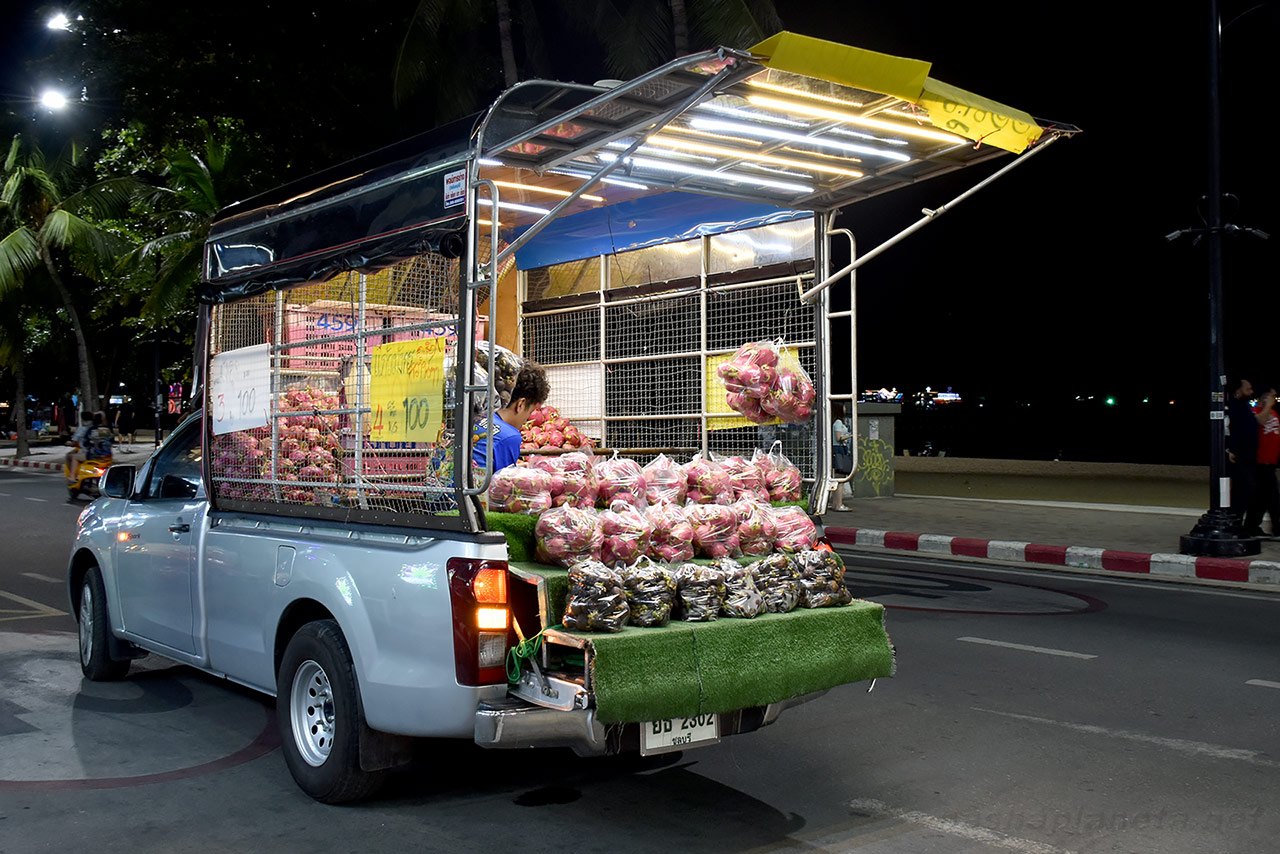
The lowest fruit prices are from farmer pickup trucks that drive around the roads. Also very cheap at fruit markets on highways outside the city and at large local markets (not tourist ones). Second option – local markets for residents. Third, the most expensive – supermarkets and tourist stalls.
Minimum fruit prices in season at city markets (in baht per kg):
- Mango – 50–60 baht (1.64 USD). Peak season – April–May.
- Mangosteen – 50 baht (1.49 USD). Peak season – May–September.
- Rambutan – 40–50 baht (1.34 USD).
- Longkong – 50 baht (1.49 USD).
- Dragon fruit (Pitahaya) – about 60 baht (1.79 USD).
- Durian – 120–150 baht (4.02 USD) in season (June–August). An average fruit (2 kg) – 240–300 baht.
- Lychee – 70–80 baht (2.23 USD) in season (April–June), out of season – up to 150 baht.
Prices can be almost half of these if you buy from farmer pickup trucks or at wholesale markets outside the city, especially when buying 2–3 kg or more. At tourist markets and supermarkets, prices are usually higher.
Drinks and Alcohol: What to Drink and What to Skip
In Thailand, you can't drink unboiled tap water. Always buy bottled water or fill your bottles from water dispensers – they're everywhere, 1 liter costs just 1 baht. This is the most economical option. Bottled water at 7-Eleven: 1.5 liters costs about 15 baht (0.45 USD).
Among non-alcoholic drinks, be sure to try Thai iced tea with milk (Cha Yen) – sweet, orange, and refreshing. Price – 20–30 baht. Also local energy drinks – M-150, Shark, Red Buffalo. They give you a boost, but don't drink more than one bottle a day.

Alcohol in Thailand: Types and Prices
Important! Since December 2025, the ban on alcohol sales from 2:00 PM to 5:00 PM in Thailand has been lifted. Now you can buy alcohol from 11:00 AM to midnight without interruption. This makes life significantly easier for tourists.

-
Beer
Local beer is excellent quality. The most popular brands are Singha, Leo, Chang. Singha is stronger (6%), Leo and Chang are lighter. In a store, a large bottle (0.65 L) costs 60–65 baht (1.85 USD), in a bar – 75–100 baht. Don't take "Heineken" or "Carlsberg" – they're more expensive, and the quality isn't better than local.
-
Whiskey and Rum
This is where it gets interesting. Local whiskey costs pennies, but the quality… let's say, it's an acquired taste. The legendary Mekong (with herbs) – 145 baht for 0.33 L (4.32 USD). Hong Thong – same. The most budget option is Lao Khao (rice moonshine) – from 61 baht per bottle (1.82 USD). Our verdict: take it for cocktails with cola, but your head might hurt in the morning. We've tested it ourselves. Better pay 350 baht for Blend – it's smoother.
The most popular Thai rum is Sang Som. It's drunk with cola or soda.
-
Wine
Local grape wine isn't the best idea – it's sour and harsh. Palm or fruit wine is exotic, but an acquired taste. Imported wine in restaurants is expensive due to duties.
-
Coconut cocktail (homemade)
Take a fresh coconut, drink some of the juice, add some rum or whiskey. A refreshing and invigorating drink. Just don't overdo it with the alcohol – coconut milk can amplify the effect.

Food Safety: How Not to Get Sick
The most common fear tourists have is getting sick. We believe that if you follow a few simple rules, the risk is minimal.
- Watch the crowd. If the stall is empty – don't risk it. If there's a crowd around – go ahead.
- Eat freshly cooked food. Better to wait 5 minutes for them to cook it for you than to take something that's been sitting under a lid for an hour.
- Don't drink tap water. Even for brushing your teeth, use bottled water. Ice in drinks is made from purified water – it's safe.
- Start with "no spicy." This way you'll get used to the local cuisine gradually.
- Wash your hands before eating. We always carry a small bottle of alcohol-based hand sanitizer – it's a lifesaver in any situation. At 7-Eleven, you can buy wet wipes.
If you do end up with an upset stomach, don't panic. Buy smecta or activated charcoal at the pharmacy – they're available everywhere. And Thailand has a legendary remedy – the "Flying Rabbit" emulsion. Thais have been drinking it for over 70 years for spasms, bloating, indigestion, and diarrhea. It's even sold at 7-Eleven and costs about 20 baht. It works fast – in about 20 minutes. And drink plenty of water. But honestly, in all our trips, we've never gotten sick from street stalls.
Complete guide to Thai cuisine
In this article, we've gathered the most important things for beginners. If you want to dive deeper into the details, learn more about each dish, recipes, and nuances, be sure to read our "big guide to Thai cuisine for tourists" – it has dozens of dishes, detailed descriptions, and personal recommendations.
And if you're also interested in alcohol, read the separate article "All About Alcohol in Thailand (with Real Prices)."