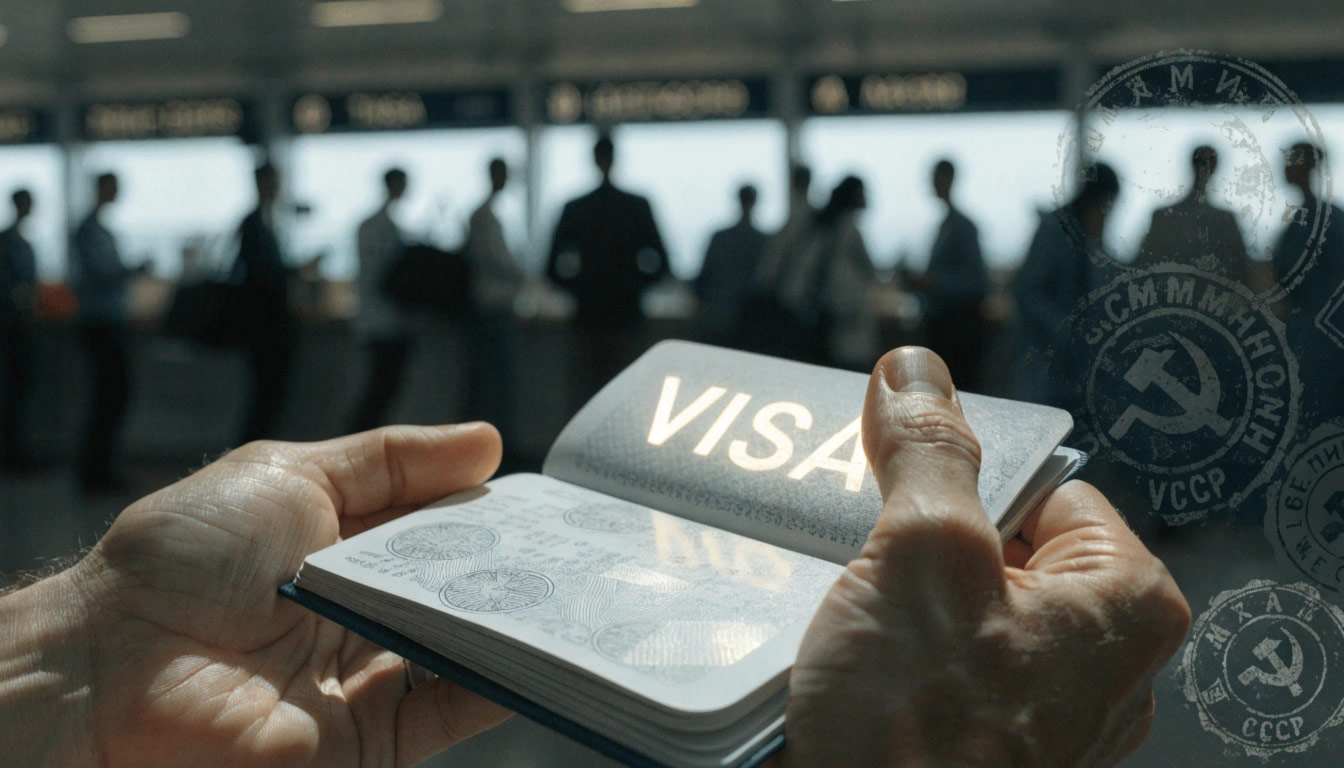
Imagine this: you're calmly planning your vacation, choosing a hotel, comparing flight prices – and then a headline pops up in your news feed: "Russians may be banned from leaving the country without special visas." Your heart skips a beat, and you instinctively double-check your passport expiration date. Sound familiar?
On July 10, 2026, such a wave swept through social media and messaging apps. The trigger was media reports claiming that Russia's Foreign Ministry was supposedly drafting a law to introduce exit visas for citizens.
Foreign Ministry spokesperson Maria Zakharova's response was short and blunt: "Nonsense. Classic foreign-agent rhetoric." In an interview with TASS, the diplomat emphasized that there wasn't even any talk of such a measure.
Seems like a clear answer, right? But the question remains: where did these rumors come from in the first place? And more importantly – should we even be worried?
Where the wind blows: the March story that won't die
The exit visa rumors didn't come out of nowhere. Back in March 2026, Sangadzhi Tarbaev, head of the State Duma's tourism committee, supported the idea of creating a guarantee fund to evacuate Russians stranded abroad in crisis situations – funded by a fee collected from departing tourists. The reason was serious: the conflict in the Middle East, when hundreds of independent travelers couldn't get home.
Around the same time, Ilya Umansky, president of the Russian Union of Travel Industry, proposed charging every departing traveler a small mandatory fee – about 100 rubles per person. The idea was to build a fund to quickly evacuate tourists from war zones or natural disaster areas. Tour operators had evacuated their clients, but independent travelers were left stranded.
The media latched onto this idea and started spinning it as an "exit tax." Then – as an "exit visa." The chain of distortions worked like a game of telephone.
Tarbaev had to issue a denial: "There are no legislative initiatives regarding any fees for leaving the country, let alone a special tax. Absolutely none."
So what was actually discussed? How much would we have paid if the idea had moved forward? Amounts mentioned ranged from 100 to 300 rubles per person per departure. In 2025, about 31.5 million Russians traveled abroad. At 300 rubles per person, that would bring in roughly 9.5 billion rubles annually. That sounds like serious money. But here's the key point: the discussion wasn't about punishment or restrictions – it was about a safety net. 100 rubles is the price of a cup of coffee. Yet even that amount sparked a strong reaction. People are tired of any new fees and daily initiatives to ban something.
What about the rest of the world? Spoiler: we're not unique
In the comments under posts about "exit visas," outraged voices appeared immediately: "Our authorities are at it again!"
But let's be honest: exit taxes are a global practice. And some countries have gone way beyond Russia in terms of such fees.
Take Japan. Since 2019, they've had what's known as a "sayonara tax" – a departure tax. Starting July 1, 2026, it will increase from 1,000 to 3,000 yen (roughly 2,000 rubles at current exchange rates). And this isn't a rumor – it's a passed law.
In Australia – the "Passenger Movement Charge" – 70 Australian dollars (about 50 USD) per departing passenger.
In South Korea – 8,000 won (about 5 USD), in the Philippines – from 1,620 to 2,700 pesos (2,000–3,300 USD).
In Thailand, China, Cambodia, Indonesia, Malaysia, Egypt, Germany, the UK, and the Philippines – departure fees are included in ticket prices, and tourists often don't even realize they're paying them.
So Russia isn't a pioneer here – it's actually lagging behind. The idea was floated, discussed, but never made it to legislation.
A history lesson: when leaving was a real quest
Now let's take a moment away from the rumors and recall how things worked with travel in the USSR. To understand why today's discussions trigger such strong reactions, it's worth looking at the recent past. The "Iron Curtain" isn't just a metaphor from textbooks. For several generations of Soviet citizens, foreign travel was an unattainable dream.
Unlike modern Russia's Constitution, which explicitly guarantees the right to free travel (Article 27), the 1977 USSR Constitution did not provide for such a right. Formally, it was derived from the right to rest and to enjoy cultural achievements, but in practice, things looked very different.
How did it work in reality?
- A permit system. To simply leave the country, a Soviet citizen needed special permission – an exit visa. Officially issued by the Ministry of Internal Affairs' Visa and Registration Department, but in practice – by the KGB.
- A bureaucratic nightmare. First, you needed permission and a positive reference from your workplace or school. Then – interviews and commissions at the trade union committee and party bodies. People could be rejected at any stage without explanation.
- First-time geography. Even if you passed all the hurdles, "real abroad" was out of reach for first-timers. Those wanting to go to Hungary were told: "first you need to go to Bulgaria." Travel to capitalist countries was a privilege for the select few.
- Cost and accessibility. A foreign passport cost about as much as an average monthly salary, and you needed to gather a stack of certificates to travel.
In the early 1980s, up to 3 million citizens traveled abroad annually through all channels (including work trips) – with a population of almost 280 million. An ordinary person returning from a tourist trip even to Bulgaria became an object of envy and curiosity.
Only on May 20, 1991, when the law "On the Procedure for Exiting and Entering the USSR" was passed, the Iron Curtain finally fell. From then on, all that was needed for travel was a foreign passport and an entry visa from the destination country. 35 years have passed, but the collective memory of those times is still alive.
That's why any talk of "exit visas" or "fees" triggers such a strong reaction. People aren't afraid of 100 or 300 rubles – they're afraid of a return to a system where travel wasn't a right but a privilege that had to be earned. A system where a person could simply be told "no."
So what's actually going on? No fluff, no naivety
We have two pieces of news: one bad, one good.
The bad: rumors about "exit visas" will keep popping up. Every time an official or expert publicly ponders how to protect tourists abroad, the media and social media will blow it up into "a ban on travel."
The good: at this moment, no bills on exit visas or exit taxes have been submitted to the State Duma for consideration. This is the official position of both the Foreign Ministry and the State Duma.
But let's be realistic. We all remember how some initiatives were denied, only to be introduced later – under different names, with different wording. Recent years have taught us: "it doesn't exist right now" doesn't always mean "it will never exist."
So here's our take:
- On one hand, there is no bill, no official document introducing exit visas or an exit tax. That's a fact. And as long as it remains a fact, panicking is just wasting your nerves.
- On the other hand, trust in official denials has been undermined for many, and that's also a fact. Ignoring it means closing your eyes to reality.
In our opinion, the important thing now is: don't let rumors dictate your plans. If you're planning a trip – go for it. Check your passport, book your tickets. And if ever (emphasis on if) there are real developments – they'll go through proper legislative channels with public discussion, not suddenly appear as a "surprise" the day before your flight.
One more piece of advice: follow primary sources, not rehashes on Telegram channels. As this story has shown, a chain of distortions turned an expert proposal for an evacuation fund into "exit visas." And between those two concepts lies a chasm.
Plan your vacation calmly. And don't believe every headline – especially if it contains the word "nonsense." Usually, behind it is a very specific denial. But staying alert, you'll agree, doesn't hurt either.