In short: what to do with money in Pattaya
If you don't want to read the whole text, here's our ready-made algorithm based on experience and real calculations over years of travel:
Choose your scenario:
- You're on a 10-14 day package tour, everything major is paid for. You only need pocket money, souvenirs, and a couple of excursions. Bring about 500 dollars in cash (new or old, but in perfect condition) and get a ruble or yuan UnionPay card from RSHB. Don't bother hunting for the best rate – the difference of a couple hundred baht isn't worth your time.
- You're an independent traveler with a budget of $1000 or more. Then it's worth looking for new dollar bills in Russia (or old ones, but in perfect condition). In Pattaya, look for T.T. Exchange or a couple of spots we'll mention below – their rates on old bills can be the same as on new ones. Be sure to get a yuan UnionPay card and top it up through a broker (not through the bank's app) – this will save 1–2% on every purchase. Pay with the card wherever possible. Withdraw cash only as a last resort.
- Never bring large amounts in rubles – it's the worst option. Keep rubles as a reserve in case you misjudged your budget and are completely out of money.
Want to calculate your trip budget precisely? We've prepared a handy calculator to help you estimate expenses on food, transport, entertainment, and accommodation in Pattaya. Go to the expense calculator →
If you don't like reading long guides, we've recorded a detailed video where we show and explain the best exchange offices, break down rates, and how not to lose on fees. Everything from the article, but in motion – watch and remember:
Where to exchange currency in Pattaya: our exchange office ranking
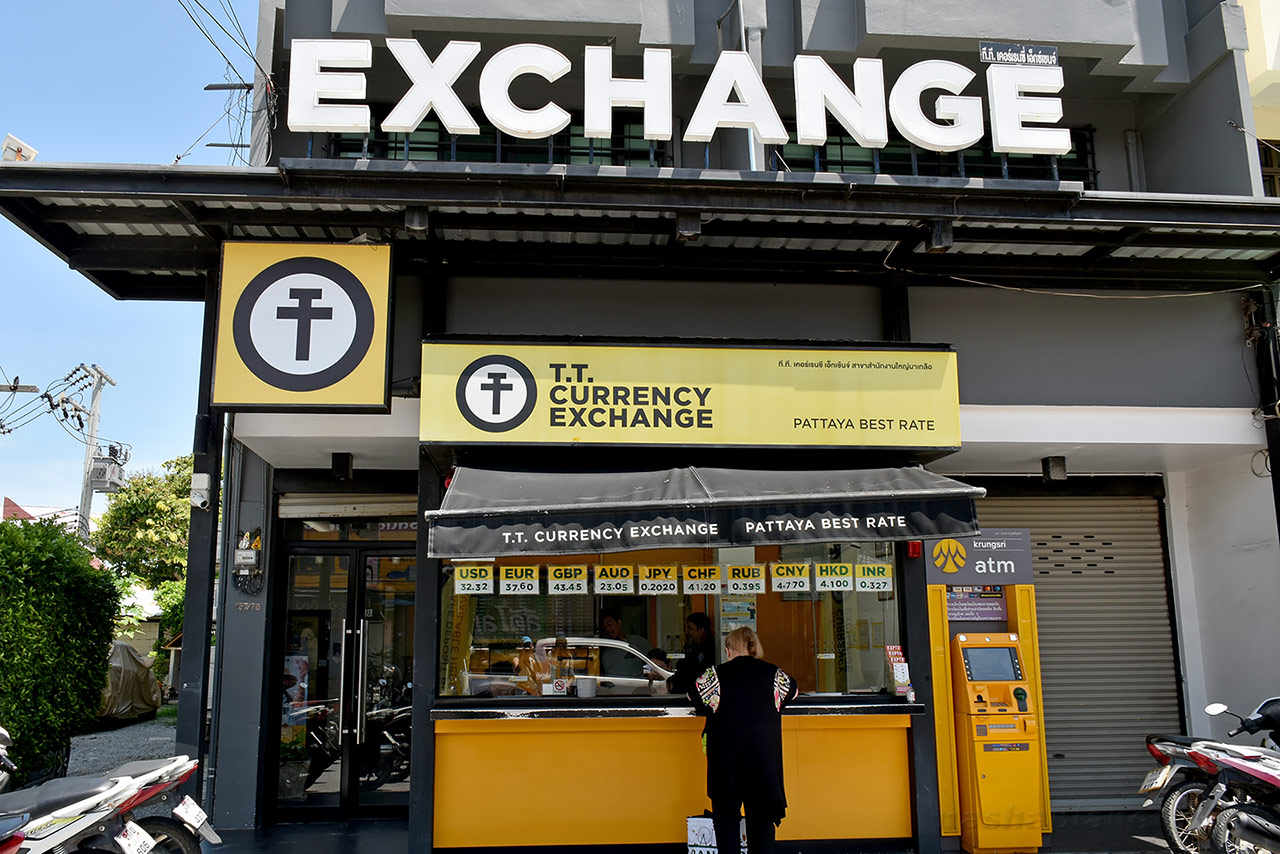
Exchange offices in Pattaya are like mushrooms after rain, especially in tourist areas. But the rates vary. We've gone through the main ones and highlighted the best options.
T.T. Exchange – the main chain player
This is the chain we recommend first. They have many branches across Pattaya, and the rate is consistently higher than banks and most private exchange offices. Even between their own branches, the rate can differ. For example, when exchanging $1000, the difference could be 50–100 baht (1.48–2.97 USD). Is it worth running around the city for that? You decide.
Always check the rate on their official website https://ttexchange.com/ before exchanging. There's also a branch map. We usually check and compare with neighboring exchange offices. A difference of 1 baht per dollar when exchanging $100 means a loss of 100 baht (2.97 USD). It happens sometimes.
New Superrich in Pattaya – are they worth it
In 2026, branches of the famous Superrich exchange chains appeared in Pattaya – both networks (green and orange). We personally checked them and compared them with T.T. Exchange. Here's where they are:
- Green Superrich – in central Pattaya, at Central Pattaya mall (formerly Central Festival) on the first floor, near the Hilton hotel entrance. open on map.
- Orange Superrich – in north Pattaya, at Terminal 21 mall, open from 11:00 AM to 8:00 PM. open on map.
Honestly, their rates are no higher than local T.T. Exchange, and sometimes even slightly lower. So you don't need to specifically look for Superrich – you'll get the same good rate at a nearby T.T. branch. But if you're already near these malls, you can compare rates on the spot and choose the better one. We always compare – sometimes a 0.1–0.2 baht difference is in favor of one network or the other.
Two spots with rates higher than T.T.
We found a couple of places where the rate was sometimes even higher than at T.T. Here's the tip:
- Exchange office near Rom Pho Market (Jomtien area) – open on map.
- Cash & Go exchange office in the Pratumnak area – open on map.
But we can't guarantee it will always be better there. The situation changes. Use it as a reference and check the rate on the spot.
Russian-speaking exchange offices: when you need them
In Pattaya, there are several exchange offices with Russian signs (e.g., SenateExchange and Ex24Pro). The cash rate there is usually lower than at T.T. – that's not their main business. But they can be useful if you want to:
- Withdraw cryptocurrency into cash baht.
- Transfer non-cash rubles to a card or get baht without ATM withdrawal fees.
Unlike "gray" exchangers from Telegram channels, these are licensed organizations. The risk of being scammed is minimal. But the rate is not for saving money.
Important: We strongly advise against using private money changers from Telegram and Facebook. Unfortunately, scams are not uncommon. The most popular schemes: "money transfer via ATM" (they don't send you the code), "courier with cash" (they come, take the transfer, and disappear). Don't take the risk.
Which currency to bring to Pattaya: dollars, euros, yuan, or rubles
We've already done a detailed calculation for Thailand in general, and it fully applies to Pattaya. The bottom line is that it's best to bring cash dollars (new or old, but in perfect condition). Euros and yuan are slightly worse. Rubles are the clear loser.
Here's our example for 100,000 rubles:
| Exchange method | Currency buying rate in Russia | Intermediate currency received | THB rate in Thailand | Final amount in THB | Difference from USD in baht | Difference from USD in % |
|---|---|---|---|---|---|---|
| Through old dollars (USD) | 84.99 RUB/USD | 1,176.61 USD | 33.09 THB/USD | 38,934 THB | 0 | 0.00% |
| Through euros (EUR) | 98.2 RUB/EUR | 1,018.33 EUR | 37.87 THB/EUR | 38,564 THB | -370 | -0.95% |
| Through yuan (CNY) | 12.85 RUB/CNY | 7,782.1 CNY | 4.94 THB/CNY | 38,443 THB | -491 | -1.26% |
| Through new dollars (USD) | 86.65 RUB/USD | 1,154.07 USD | 33.09 THB/USD | 38,188 THB | -746 | -1.92% |
| Cash rubles in Thailand (Superrich Bangkok) | Rate in Thailand: 0.37 THB/RUB | Direct exchange | 37,000 THB | -1,934 | -4.97% | |
| Non-cash rubles in Thailand | Rate in Thailand: 0.34557 THB/RUB | Direct exchange | 34,557 THB | -4,377 | -11.24% | |
| Cash rubles in Thailand (TT Exchange Pattaya) | Rate in Thailand: 0.335 THB/RUB | Direct exchange | 33,500 THB | -5,434 | -13.96% | |
| Cash rubles in Russia (Sber) | 30.33 RUB/ 10 THB | Direct exchange | 32,970 THB | -5,964 | -15.32% | |
As you can see, via dollars you get almost 3,000 baht more than exchanging cash rubles in Thailand, and 1,000 baht more than via yuan. Conclusion: take dollars if you have a choice.
Old dollars in Pattaya: will they accept them or not
One of the main fears of tourists is that old dollars aren't accepted at all. Travel agents and guides spread this fear. Yes, old dollars (without the blue security strip) are accepted reluctantly and not at every exchange office, but it's not all that bad. In fact, in Pattaya, there are almost no big problems with exchanging old bills, and you'll definitely exchange them if they are:
- In perfect condition: no wear, folds, tears, markings, or stamps.
- Denominations of 50 or 100 dollars. Small bills (1–20 dollars) are exchanged at a lower rate, and old small bills may not be accepted at all.
Where will they definitely accept old dollars? T.T. Exchange – they almost always take old bills, at the same rate as new ones – this has been tested many times. Also try Superrich – they're also generally accepting. At street "no-name" exchange offices, the rate on old bills may be 0.1–0.5 baht lower than on new ones, but that's a loss of about 0.5–1.5%, which isn't critical compared to how much you'd overpay for them at home.
If one exchange office refuses – just go to the next one. This is not a problem in Pattaya.
Exchanging rubles in Pattaya – when it makes sense and when it doesn't
In short: exchanging rubles in Pattaya is like buying business-class tickets when you could fly economy – you get the same thing, but pay more. Our calculations above show that the loss on direct ruble exchange can be up to 10% compared to dollars. But of course, it's up to you.
There are four scenarios where exchanging rubles makes sense:
- You forgot to bring another currency and are out of money. Then yes, exchange a bit of rubles at T.T. (they accept cash USD) or at a Russian-speaking exchange office.
- You overspent your budget, and again, you're out of money.
- You're in Pattaya long-term and receive your salary in rubles on a Russian bank card. But to make it more profitable, consider a transfer via crypto – it's more profitable and completely legal. Or another option – via a UnionPay card.
- You need a FET certificate (confirmation of funds from abroad) for buying property or other purposes, but such an exchange should only be done through licensed exchange offices mentioned above.
In all other cases – don't take rubles. Better buy dollars or euros in Russia.
Bank cards in Pattaya: UnionPay, fees, and pitfalls
Cards are accepted everywhere in Pattaya: from 7-Eleven to expensive restaurants. But there are nuances that can hit your wallet hard.
Which cards work and how much it costs
MIR cards do not work in Thailand – that's a fact. Of the Russian cards, only UnionPay from non-sanctioned banks work. Currently – mostly Russian Agricultural Bank (RSHB) and ATB. Cards from Gazprombank, Tinkoff, Pochta Bank, and other major players no longer work abroad.
Important: Even if you have an RSHB card, the rates may differ. Don't trust bloggers who write "withdrew without fees." They may have had a different rate or met turnover conditions. Check the conditions of your specific card.
We compared the main RSHB UnionPay card rates. Here are the real numbers (current at the time of writing):
| Rate / card currency | Issuance | Maintenance | Withdrawal fee at Thai ATMs | Payment fee at terminals |
|---|---|---|---|---|
| "Svoi karta plyus" / yuan | 380 CNY | Free | 4% (min 70 CNY) – free if turnover > 30,000 RUB in previous month | No fee |
| "Svoi karta plyus" / ruble | Free (first) | Free | 1.5% (min 250 RUB) – free if turnover > 30,000 RUB | No fee |
Note: the ATM withdrawal fee is only the Russian bank's fee. On top of that, there's a Thai ATM fee (more below). So withdrawing cash from a card is almost always unprofitable.
ATMs: why withdrawing cash is almost always a bad idea
ATMs in Pattaya are on every corner. But every time you withdraw money, you lose:
- Fixed Thai ATM fee – 200–220 baht (6.52 USD) per transaction.
- Your bank's fee – as we see from the table, for an RSHB yuan card, this is 4% (min 70 yuan), for a ruble card – 1.5% (min 250 USD).
Plus conversion. If you have a ruble card, the conversion from rubles to baht is at the bank's rate, which is usually 1–2% worse.
Bottom line: Withdrawing from a card in Pattaya is only worth it in emergencies. If you absolutely must, try to withdraw the maximum amount at once (usually 10–20 thousand baht) so the fixed 220 baht fee doesn't hit your pocket too hard.
Paying with a card in stores and restaurants is a different story. There's no extra fee, and the conversion rate (for ruble cards) is usually reasonable. This is more profitable than exchanging cash if you have a yuan card and topped it up via the exchange.
At 7-Eleven, you can only pay by card for receipts of 200 baht or more. This is the chain's restriction, not the bank's. Other stores usually don't have this.
Some cafes and private shops may add 3–4% to the bill for card payments. They usually warn you, but it's better to check the terminal amount.
Payment by QR code via Russian apps
In Pattaya and Thailand in general, payment by QR code via Russian bank apps SberBank and MTS Bank works. You can pay in many places: from supermarkets to markets. If you see a sign with a QR code or the words Thai QR – it means you can pay.
The process is no different from regular payments in Russia: open the app, scan the QR code, confirm the amount. The only condition is mobile internet (or the seller can share Wi-Fi).
We tested this method and calculated the real losses. It turns out that payment by QR code eats almost 7% compared to paying with a yuan UnionPay card topped up through a broker, and about 4% compared to a ruble UnionPay card.
For small purchases (up to 500–1000 baht), this is acceptable and convenient. For large expenses, it's better to use card payment or cash.
Cryptocurrency in Pattaya: it works, but with caveats
Thailand has officially launched the TouristDigiPay program, which allows tourists to legally pay for purchases with cryptocurrency. Sounds cool, but in practice, for the average tourist, this is almost inaccessible.
How it's supposed to work:
- You register on an exchange (Bitkub, Binance TH), complete full verification (KYC).
- You exchange crypto for digital baht (THBS).
- Through apps (e.g., Q Wallet or TagThai), you pay for purchases via QR codes.
Problems for travelers from Russia:
- Registration only on a local SIM card.
- Verification requires personal presence at a center with a passport and proof of address in Thailand (rental contract).
- Russian citizens have restricted access to Binance TH and Bitkub.
- Limits: 50,000 baht per month for regular payments and up to 500,000 baht for purchases from verified sellers.
We couldn't test this scheme ourselves precisely because of the restrictions against Russia and the document requirements. For a short trip, it's too complicated. If you're staying for the winter and willing to deal with paperwork – give it a try. But for most tourists, crypto in Pattaya remains exotic.
Summary table: comparing payment methods
For clarity, we've compiled all options into one table. Use it as a cheat sheet.
| Method | Average loss (fees + hidden rate) | When to use | Rating |
|---|---|---|---|
| Cash dollars (new or old) via T.T. | 0–0.5% | Main method for large amounts | ✔ Best |
| UnionPay card payment (yuan) | 0% (if no seller fee) | Everyday purchases, if the card is already topped up | ✔ Excellent |
| Cash euros or yuan | 1–3% (depends on purchase rate in Russia) | If you don't have dollars but already have euros/yuan | ⚠ Acceptable |
| Cash withdrawal from ATM | 4% + 220 baht + conversion | Only in emergencies | ❌ Bad |
| QR code payment (Sber / MTS) | ~7% (compared to yuan card) | Small purchases when you have no card or cash | ⚠ Acceptable for small amounts |
| Cash rubles (exchange in Pattaya) | 7–10% | Only as a reserve if you have no other money | ❌ Very bad |
| Cryptocurrency via official exchanges | Depends on exchange fees, but hard to set up | For long-term stayers with documents | ⚠ Exotic |
Our final advice for Pattaya: Bring cash dollars (new or old – not critical, main thing is perfect condition), exchange at T.T. Exchange, pay with UnionPay cards wherever possible. Withdraw cash only in emergencies, and preferably in large amounts. Save rubles and crypto for other experiments.