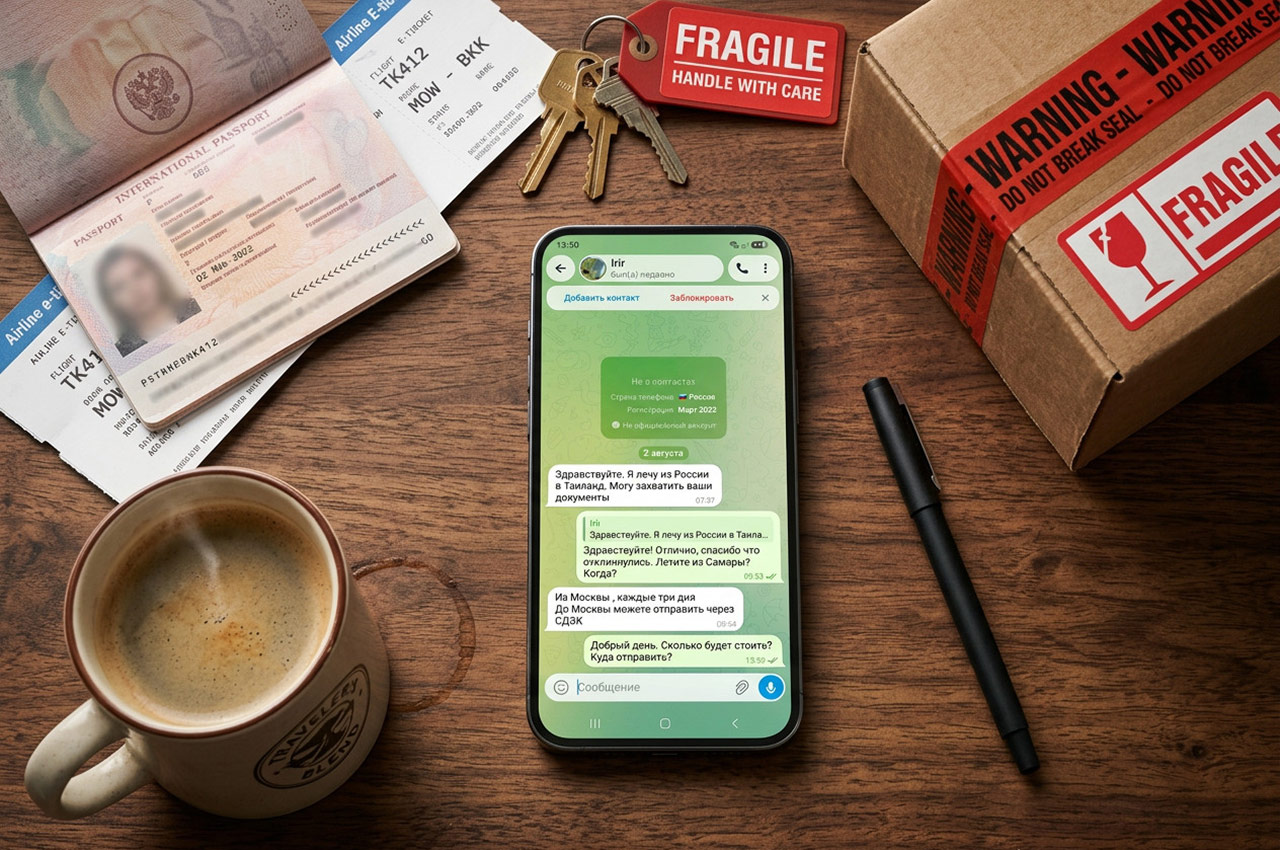
The Sweet Lie of Relocation: Why We Trust Strangers
International shipping today is a headache. Russian Post sends parcels to Europe as if by foot courier across all of Eurasia, and they can get stuck in sorting centers for weeks. Since 2022, DHL and FedEx have effectively suspended direct shipments to Russia, working through intermediaries with sky-high prices. In this situation, mutual aid chats on Telegram and WhatsApp* have become a lifeline for thousands of relocators and travelers.
The logic is simple: "One of us won't deceive." We've gotten used to trusting fellow countrymen abroad. We share a language, common problems, and the chat seems "verified." It feels like someone writing in Russian and complaining about the same visa issues simply can't be a fraudster. And on top of that, another "trusted" chat member vouches for them. How can you not trust them?
But scammers are smart. They've long understood this weakness. It's this excessive trust combined with constant rushing that shuts off our common sense. The result: a simple desire to send medication to mom or a laptop forgotten in Russia to a friend turns into losing money, nerves, and valuable items.
* - Meta company is recognized as extremist in Russia
Anatomy of Deception: 4 Schemes Even IT Pros Fall For
Telegram scammers no longer work with old templates. They use automated bots that track keywords in chats – "I'll carry," "traveler," "Moscow-Istanbul," "help with delivery." As soon as you post a request, the bot instantly finds you and passes the contact to the scammer.
We've broken down four of the most common schemes. They look so logical that even programmers and managers fall for them.
Scenario 1: "I'm in Sochi, Send It to Me via CDEK"
You post in the chat: "Looking for a traveler Moscow – Berlin, need to send documents." Within a couple of minutes, a friendly person messages you privately. They say they're flying in two days but are currently in Sochi on a business trip – they'll fly to Moscow right before the flight.
The offer sounds reasonable: "Send the item via CDEK, Boxberry, or 5Post to my pickup point in Moscow, I'll pick it up and fly out." You check – the person has a good rating in the chat (which, by the way, is easy to fake), a family profile picture, and a polite conversation.
Then it goes one of two ways:
- If the item is expensive – you send an iPhone or laptop via a delivery service. The scammer picks up the package in their city, deletes the chat, and disappears. You don't even know their real name.
- If the item is cheap – they ask for a prepayment for the luggage space. They say tickets are expensive, can you chip in 30 euros for gas to the airport. You transfer, they vanish.
One result: your sweater, books, or documents end up in the nearest trash can, and the money goes into the fraudster's pocket.
Scenario 2: A Psychological Thriller at Sheremetyevo
This scheme is for the most cautious – those who demand a face-to-face meeting and refuse prepayments. The scammer easily agrees: "Let's meet at the airport 2 hours before departure." You calmly head to Sheremetyevo, confident everything is under control.
30–40 minutes before the meeting, a panicked message arrives in Telegram. The traveler writes that they're stuck in a traffic jam on the Moscow Ring Road, running late for check-in, rushing straight to security. But they're "an honest guy" and left the items with a friend who's standing at the airport entrance. The friend will pass the package, and payment can be sent later.
In stressful situations, people lose vigilance. You hand over an expensive item to the first person you see, who disappears into the crowd within a minute. The "traveler" immediately blocks you.
There's an even bolder version. The scammer doesn't hide behind a "friend." They show up at the airport, calmly get in the check-in line, and wait for you there. You see them with a ticket in hand, with a suitcase – the full illusion of a real passenger. They take your package, receive the promised payment for the service, say: "I'll check in now and put it in the luggage." An hour later, you're banned from the chat, and your item is flying somewhere far away from Phuket.
Advice: If you're told there's no time and you need to hand over the item urgently – that's already a reason to be suspicious. An honest person will always have a couple of minutes to record a video or give a booking code.
Scenario 3: The Low-Value Parcel Trap
Many think scammers only want iPhones, MacBooks, and stacks of documents. That's naive. Scammers make great money on volume.
They readily agree to transport a box of old photos, a blanket, or a jar of jam. The real goal is the service fee. They charge you a modest 20–100 euros "for gas" or "for excess baggage," take the box, and disappear.
The value of your item doesn't matter to them at all. They need hundreds of such "clients" a day. The irony is that you're paying to be scammed.
Important: scammers always ask to transfer money to an individual's card, not a company account. If you see a card number – it's 99% a scam.
Scenario 4: Prepayment for a Courier Who Never Shows Up
This scheme is a pure online scam. The scammer offers you "door-to-door" delivery with a courier. You're asked to order and pay for a courier dispatch, you transfer the money, wait for the courier… and no one shows up. The chat is deleted, the number is blocked.
Important: no courier was ever called. The scammer simply takes money for nothing. The amounts are small, but they have hundreds of such "clients" a day.
How to protect yourself? Any prepayment for a courier dispatch is a red flag. Real delivery services either take payment upon delivery or have an official website with an order form, not a Telegram conversation. If someone offers a courier in a messenger and asks you to transfer money to a card – it's 100% scammers.
How Not to Become a "Blind Mule": The Danger No One Talks About
There's also a flip side that could cost you your freedom. Sometimes scammers are looking not for senders, but for travelers. You're offered a side job: carry a sealed box of "cosmetics" or "baby food" for a good reward. Sounds harmless, right?
Agreeing to this is a huge risk. Carrying sealed packages from strangers is playing Russian roulette with the criminal code. Inside could be drugs (Article 228.1 of the Russian Criminal Code – 10 to 20 years), potent substances, or smuggled currency. You'll be the one answering to customs. And explaining to customs officers that you just "wanted to help someone in a chat" sounds ridiculous only in theory. In the end, investigators and the court will simply say you were trying to create an alibi, and punishment will be inevitable.
Also remember: when exporting cash over the equivalent of 10,000 USD, you need to fill out a declaration. If someone offers to carry money without declaring it – that's already a violation.
The Trap: "Official Carrier" Accounts
Some scammers go further than simple "travelers." They create Telegram accounts styled like official carrier sites – they put the company logo, add a link to the real website in the description, and call themselves a "logistics manager." It looks solid. And many let their guard down: "If it's an official representative, it's trustworthy."
But the truth is that anyone can create any Telegram account in 5 minutes. Even you could set up a profile called "Aeroflot Official" or "CDEK Support." It means nothing.
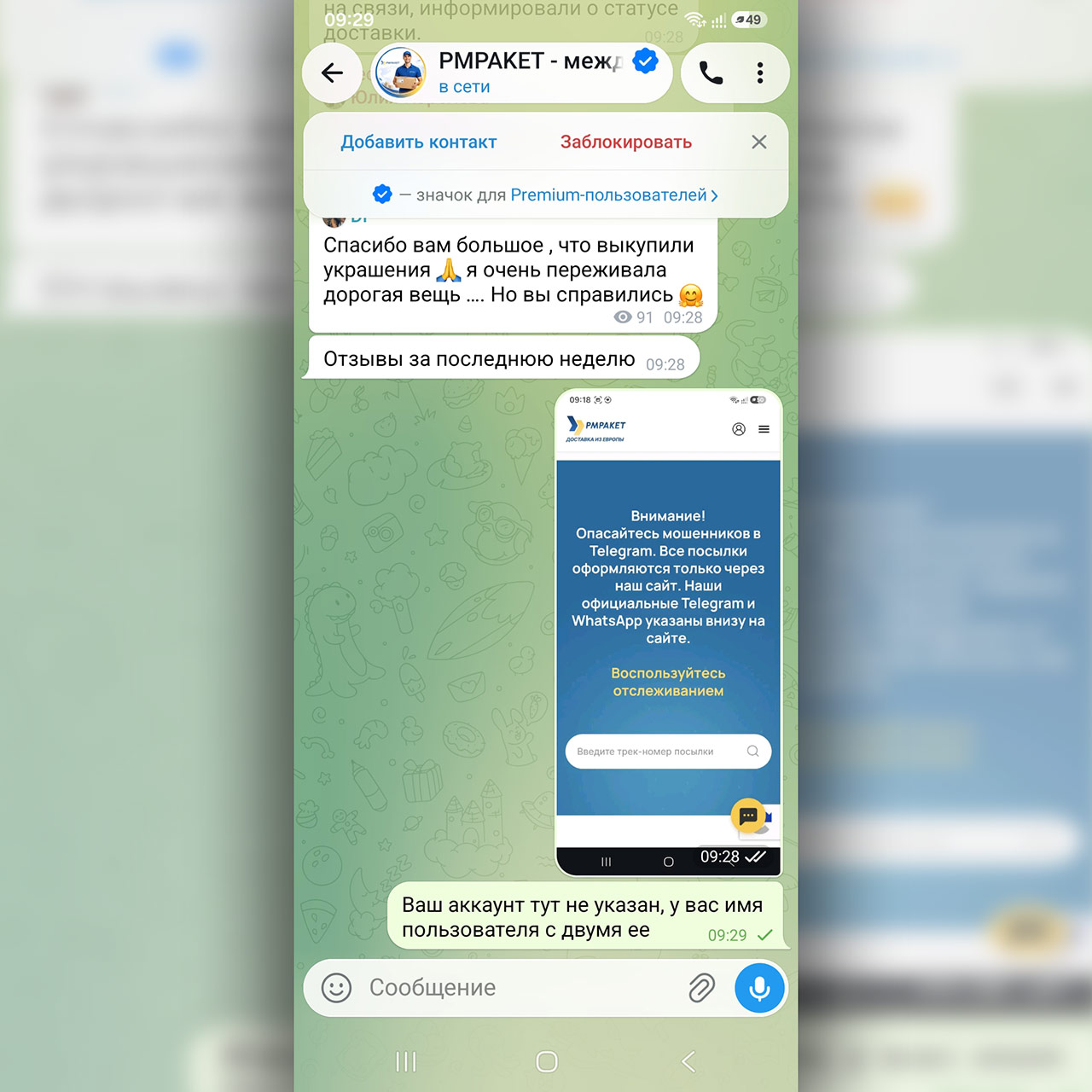
How to check? The only reliable way is to find official contacts on the company's website. If there's no link to a Telegram channel or account there – then it's not official. But even here you need to be careful: scammers often spoof names to look like the original. For example, the official account is @pmpaket, while the scammer creates @pmpakeet – one extra letter and you don't even notice the difference.
Remember: official carriers never message you first and never offer services through Telegram accounts unless you found them through the website. If a "representative" messages you – it's almost always a scam.
Turning on Healthy Paranoia: A 4-Step Checklist
You can protect yourself from these schemes in only one way – completely turning off blind trust. No matter how nice the person is or how many "verifications" or recommendations from other "friends" in the chat they have, check every step:
- No money upfront. An honest traveler will easily agree to get paid upon delivery at the final destination. If they demand a "booking deposit" or "prepayment for excess baggage" – that's a red flag. Even 10 euros.
- Verify the flight booking. Ask for the booking code (PNR) and last name. Go to the airline's website or app and check the flight's validity. Scammers usually send fake screenshots made in Photoshop. A real PNR code works. If the airline's website doesn't find the booking – ask for another code or call the call center.
- Live contact. First, ask them to record a short video circle in Telegram right now – the person must say the current date, your name, and say something spontaneous (at least 10 seconds long). This eliminates bots and people using stolen accounts. Then take their regular phone number and call them – not through a messenger, but via cellular network. Scammers rarely give real numbers and are afraid of voice contact. If your interlocutor starts making excuses ("bad connection," "I'm abroad, can't call," "let's use Telegram") – it's almost a 100% sign of a scam.
- Control the contents (for carriers). Never accept or hand over completely sealed boxes. The item must be open for inspection. This applies to both you and your traveler. If a person refuses to show what they're carrying – goodbye.
What is a PNR code and how it catches scammers
A PNR code is a six-character alphanumeric code that the airline issues when you buy a ticket. For example, KJ8F3M. It's like the serial number of your booking – unique and unrepeatable.
Where to find it? In the confirmation email from the airline or agency, in the mobile app – usually labeled as "Booking code," "Booking reference," or simply "PNR." In some low-cost carriers, it may be 5 letters – that's also normal.
How to verify a traveler? Ask them to send you this code and their last name in Latin letters (as on the ticket). Then go to the airline's website, find the "My Bookings" or "Manage Trip" section, and enter these details. If the system shows the flight, date, time, and status "confirmed" – the person is actually flying. If it shows an error or says the booking wasn't found – you're dealing with a scammer who faked a screenshot.
Important! Some scammers may buy a ticket and then cancel it – then the code technically exists, but the booking is already void. So always check not just the code's existence but the booking status – it must be active ("confirmed," "completed"). You can also call the airline's call center and verify with the code – this is a 100% reliable method.
Remember: an honest traveler will never refuse to share their PNR code for verification. A scammer will start making excuses: "it's personal information," "I don't remember," "look at the screenshot." Screenshots can be faked, but a live code can't. Always use this simple check, even if the person seems very trustworthy.
From Personal Experience: How We Almost Fell for Mail and Chat Scams
A real story that happened to us
We urgently needed to send a letter with documents to Pattaya. Deadline – 15 days. The realtor in Pattaya assured us: "Send it via Russian Post, we've done it many times, letters arrive in 2 weeks, everything will be fine." We placed an order through the Post website – it proudly displayed 8–11 days delivery time, and the price was laughable – only 850 rubles.
In reality, the letter with valuable documents took 8 days just from Samara to Moscow, then got stuck indefinitely in a sorting center. The support chat fed us fairy tales: "High workload," "Your letter is under special supervision," "It's about to be sent." And so on every day. Meanwhile, submitting a search request or claim on the website was impossible – after filling out the form, it gave an error: "Something went wrong!" and that was it. Service at its finest.
The deadlines passed, and the letter was still in Moscow. We had to urgently find alternatives. All official courier services either cost as much as a round-trip ticket or honestly warned about a 20–25 day delivery time – which didn't work for us.
One option remained – traveler chat groups and local Telegram groups. But finding live ones turned out to be quite a quest. Many dead groups with hundreds of users, clearly fraudulent ones with fake reviews. In the end, we posted a request in about ten semi-live chats.
And then it began. No one replied in the chats themselves, but about a dozen scammers messaged us privately. We got a good look at their schemes:
- "Recommendations" from kind users – saying use this verified bot.
- Account-stealing bots – asked to register and enter an SMS code (this is how Telegram accounts get stolen).
- Urgent offers – send the letter via CDEK to Moscow and pay immediately, "I'm flying out tomorrow."
- Fake account – a scammer with the username @pmpakeet (instead of the official @pmpaket) posing as a well-known service. When we asked why the account didn't match the official one and why the website had a warning about scammers, they started cursing and insulting us, then deleted the chat a couple of minutes later.
The bottom line: we never sent the letter through chats. But we clearly saw that internet delivery through strangers is a pig in a poke, and Russian Post's service is beyond criticism.
Healthy Alternatives to Chat Groups: 4 Safe Options
If you don't want to risk your belongings and money, there are at least four proven ways to send a package abroad. Choose based on your situation – deadlines, budget, and how important the contents are.
- If time isn't an issue – Russian Post. Yes, it's slow. Very slow. Packages can take months, most of which they spend bouncing around sorting centers in Russia. But if you're not in a hurry and your budget is tight – it's the perfect option. Prices are low, tracking is available, insurance works. Suitable for books, clothes, souvenirs – anything you don't mind waiting months for.
- If it's urgent and expensive – CDEK, DHL, or Pony Express. All major logistics companies have international routes, but not to all countries – you can check on their websites. Delivery times – from 5 to 25 days, but the prices are steep. However, you get full transparency: tracking at every stage, insurance, official customs documents. And most importantly – no one will disappear with your iPhone.
- Hybrid warehouse-forwarders. You send the item to a warehouse in Turkey, the UAE, or Kazakhstan, and from there it's forwarded via an official route. This is a middle option in terms of price and speed – cheaper than express couriers, but more expensive than mail. Suitable for valuable items where reliability matters.
- A real traveler – but with verification. Not everyone in chat groups is a scammer. There are genuine people too. But how to find them without risk?
- Ask at a travel agency near your home. Many agents know their clients who are flying to the right country and, with their consent, can share contacts. It's almost like a referral from acquaintances. However, tourists rarely agree to carry other people's belongings, so the chance is slim.
- Go to the airport and look at the check-in counter. Yes, it's unusual, but it works. It's better to approach people who have already checked in and dropped off their luggage – they're definitely flying. But if you have a large package, asking them to take it as carry-on is no longer possible, so you need to find those who haven't checked in their luggage yet. Approach them, explain the situation. An honest person will gladly show their passport and ticket, and you can show the contents of the package. The main thing – don't be shy to ask for documents and offer to open the box yourself. If your interlocutor agrees to both – the chance of fraud is close to zero.
Our advice: For important documents and expensive gadgets, it's better to pay extra but use official delivery. And if you decide to go with a traveler – always apply the 4-step checklist, even if the person seems crystal honest.
Now you have the full picture: from cheap mail to live airport contacts. Choose based on your circumstances, but always keep your wits about you – even with a "verified" traveler.