Why exchange offices are so strict: age and condition
There are two reasons for rejection: physical condition (creases, tears, markings) and the year of issue. Since 2024, the problem with old dollars has only been getting worse. Banks and exchange offices worldwide prefer bills from 2013 or newer. Bills from 1996–2006 are already in the "danger zone" – they're either not accepted at all or exchanged with a 5–10% discount.
However, every rule has exceptions. For example, the TT Exchange chain in Pattaya or Superrich in Bangkok accept old bills at the same rate as new ones (provided they're undamaged). This is tested personal experience, and it's a lifesaver if you have old dollars left over.
Remember: even one crease on a bill can be a reason for rejection. Exchange offices often check bills against the light, and at the slightest fold, they'll send you packing. They're especially strict during high season (November–February) – when there are more tourists, the requirements get tougher.
Which currencies forgive wrinkles and which don't?
We've updated the table based on the latest data and traveler feedback from 2025–2026.
| Currency | Accept wrinkled? | Preferred year of issue? | Notes |
|---|---|---|---|
| US Dollar (USD) | ✖ (almost never) | 2013 or newer ("blue") | 1996–2006 – often rejected or discounted. But at TT Exchange (Pattaya) they take old ones at the same rate if bills are intact. |
| Euro (EUR) | ✔ (but at a lower rate) | Any, but avoid 500 euro | Wrinkled ones are accepted more often, but large bills (500) aren't accepted everywhere. |
| Yuan (CNY) | ✔ (almost always) | Any | The most forgiving currency – accepted even when wrinkled. |
As you can see, yuan is the easiest – they're accepted in almost any condition. But that's no reason to wrinkle them either. It's just that if you're choosing which currency gives you less hassle, yuan is a reliable option. However, in most countries, the universal choice is the dollar, and here everything matters: both the year and the condition.
Important nuance: in Thailand and other Asian countries, large bills – 50 and 100 dollars – are exchanged at a better rate than small ones. As for old bills – it all depends on the specific exchange office. For example, at TT Exchange in Pattaya, old dollars are exchanged at the same rate as new ones (if the bills are in perfect condition). At other places, they might refuse or lower the rate. So if you have old bills, look for trusted places – TT Exchange is one such reliable option.
Our hack: a cardboard envelope in 2 minutes
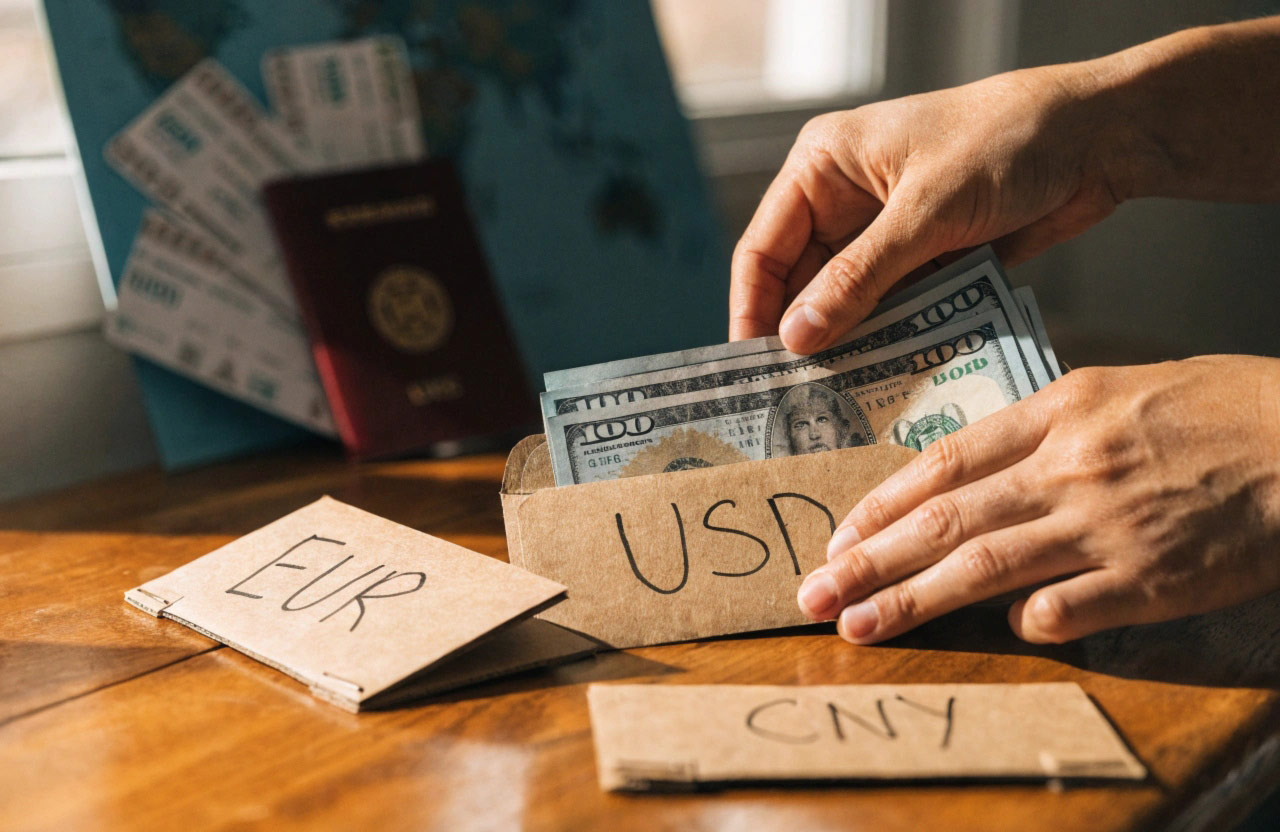
The simplest way to keep bills in perfect condition is to make a rigid cardboard envelope. We've used this method for years, and it's never let us down.
- Take a piece of sturdy cardboard (from a candy box, electronics packaging, or just thick cardboard).
- Fold it in half so bills fit inside without bending (for dollars and euros – about 16x8 cm, for yuan – slightly wider).
- Staple or tape the edges to make a flat "pocket."
- Place the bills inside in a neat stack.
- For extra protection, put the envelope in a zip-lock bag – so the money won't get wet or dirty.
No leather wallets where bills get folded, no pockets where they get crumpled. Only flat, only rigid, only in a bag. And another important tip: when you get money from a bank, always check each bill. If you're given wrinkled or marked ones – ask for replacements immediately. In Russia, this works, and it'll save you nerves abroad.
We recommend watching the video: it shows clearly how to make this envelope and exactly how to pack the bills so they arrive in one piece. Just a couple of minutes – and you'll definitely remember the sequence.
What other mistakes do tourists make with money?
Besides wrinkled bills and the wrong year, here are the classic blunders:
- Keeping all money in one place. If you lose your wallet – you're left with nothing. We always split cash between different envelopes and pockets.
- Not checking bills when receiving them. In Russia, banks may hand out wrinkled or marked bills – ask for replacements right away. Abroad, always check your change too.
- Exchanging money at street exchange offices with bad rates. Compare rates at several places, including banks. Sometimes the difference reaches 5%.
- Only carrying cash. In some countries (Europe, UAE), cards are accepted everywhere, but in Asia it's good to have cash dollars too – they often give better rates than ATM withdrawals.
- Not accounting for seasonality. In high season (November–February), exchange offices tighten their bill requirements. Better to prepare in advance.
Also worth knowing: in some countries (Cuba, Dominican Republic, China, Malaysia, Tanzania, Kenya, South Africa, Armenia), old dollars from before 2013 aren't accepted at all. And if they are, it's with a 2–3% commission. So the golden rule is: take new "blue" dollars from 2013 or newer – this is the most reliable option. But if you already have old bills, don't panic. For example, in Pattaya, the TT Exchange chain accepts them at the same rate as new ones, as long as the bills have no damage or markings. Keep them in a cardboard envelope – and you won't have exchange problems.
In short, remember the main thing: perfect condition + the right year = problem-free exchange. And if you have old bills – look for trusted exchange offices. And the cardboard envelope is your best friend in this matter.