Exotic fruits: photos and names, description, ranking of the tastiest

When you first arrive in a distant warm country, many tourists and travelers are faced with an abundance of exotic fruits, whose names they've never even heard. To help you figure out what these 'fruits' are, we've prepared the most complete overview of exotic fruits so you can decide what to buy and try, or what to do with what you've already bought. From the photos, you can identify an unknown fruit, read its description, taste qualities, ripening seasons, and also how to cut and eat it.
And if you've already tried some of these fruits, you can vote for your favorites, or write a review about them in our chat. You can see the voting results and the people's ranking of exotic fruits on this page.
Contents:
- Avocado
- Pineapple
- Bael
- Banana
- Dragon Eye
- Guava
- Soursop
- Jabuticaba
- Jackfruit
- Durian
- Fig
- Canistel
- Star fruit
- Kiwano
- Kiwi
- Coconut
- Kumquat
- Lychee
- Longan
- Longkong
- Miracle fruit
- Mamey
- Mangosteen
- Mango
- Passion fruit
- Marula
- Mafai
- Loquat
- Sugar apple
- Noni
- Papaya
- Pepino
- Platonia
- Pomelo
- Rambutan
- Buddha's hand
- Sala
- Santol
- Sapodilla
- Tamarillo
- Tamarind
- Feijoa
- Breadfruit
- Chrysophyllum
- Cherimoya
- Jujube
- Golden apple
- Dogwood
- Palmyra
- Pulasan
- Maprang
Rules for carrying exotic fruits on a plane and how much you can bring
If you decide to bring exotic fruits home, you need to know a few nuances about transporting them and bringing them into the country:
- Fruits can be carried in both carry-on luggage and checked baggage; there are no strict rules about this from airlines. Fruits can also be carried in a basket or without a basket, since there are again no restrictions or instructions from airlines if your basket meets the general weight and size allowances.
- Do not confuse carrying fruits in a basket with the 'fruit basket' service on certain charter flights. The 'fruit basket' is a paid or free service from the airline that allows you to take an additional basket of fruits of a set size and weight on board along with your carry-on luggage. The presence or absence of this service does not mean you cannot carry fruits in a basket or without one; it just means that in such a case, your fruits must fit within the weight and size limits of your checked or carry-on luggage according to your ticket.
- You cannot carry durian on a plane because of its smell, and some airlines prohibit carrying mangosteen because it may contain many ants and gets very dirty. Also, for safety reasons, carrying coconut and watermelon in carry-on luggage is prohibited.
- Airline transport rules and customs regulations are different things, and they sometimes contradict each other.
- According to Russian regulations, you can import no more than 5 kilograms of plant products, including fruits and vegetables, per person through customs. For example, if you bring 3 kilograms of vegetables and 3 kilograms of fruits, that totals 6 kilograms per person, which is a violation.
Lychee

Lychee (Litchi, Chinese plum, Litchi) is a round red fruit, up to 4 cm in diameter. A wonderful, very tasty fruit. It has one pit in the middle. Similar to Longan in shape, texture, and pit, but with a richer taste and aroma. Very juicy, sweet, sometimes with a hint of sourness. The skin easily separates from the white-transparent flesh. Lychee contains many carbohydrates, pectin substances, potassium, magnesium, and vitamin C. It has a very high content of nicotinic acid – vitamin PP, which actively prevents the development of atherosclerosis. It is believed that the widespread prevalence of Lychee in Southeast Asian countries is the reason for the low level of atherosclerosis in this region.
Unfortunately, fresh Lychee cannot be consumed all year round: the harvest season in popular tourist countries in Southeast Asia begins in May and continues until the end of July. At other times of the year, it is almost impossible to find. In the off-season, you can buy canned Lychee in Asia in jars or plastic bags in its own juice or coconut milk. Ripe fruits can be stored in the refrigerator for up to two weeks. You can freeze peeled fruits and store them in the freezer for up to 3 months.
Rambutan

Rambutan (Rambutan, Ngo) - round red fruits, up to 5 cm in diameter, covered with soft projections like thorns, which earned it the popular nickname 'hairy fruit'. Inside, there is white firm flesh with a pleasant sweet taste and the texture of very dense jelly, sometimes with a sourish tint. The pit is firmly attached to the flesh but is edible. Contains carbohydrates, protein, calcium, phosphorus, iron, nicotinic acid, and vitamin C. The fruits have a short shelf life – three weeks in the refrigerator. Rambutan is eaten fresh, made into jams and jellies, and canned. It is peeled by cutting the skin with a knife, or without a knife by twisting the fruit in the middle in opposite directions.
Harvest season: from May to October.
Mangosteen

Mangosteen (mangosteen, mangostan, mangosteen, garcinia, mankut) - fruits the size of a small apple, dark purple in color. Under the thick, inedible skin, there is edible flesh in the form of garlic cloves. The flesh is sweet with a sour note, very tasty, unlike anything else. Usually seedless, although some fruits contain small soft seeds that can be eaten. The skin of the mangosteen releases purple juice when opened, which does not wash out. It is best to peel Mangosteen with a knife, slightly cutting the skin around the perimeter, then remove it by dividing it into two halves.
Sometimes there are diseased Mangosteen fruits, with dark cream, sticky, and unpleasant-tasting flesh. Such fruits are almost impossible to identify until you open them. Sometimes you can identify such bad fruits by touch: their skin is hard and dry, almost wooden, while normal fruits have slightly soft, pliable skin.
Harvest season – from April to September.
The natural biologically active substances contained in mangosteen reduce inflammatory reactions: swelling, pain, redness, high temperature.
Dragon Eye or Pitahaya

Pitahaya or pitaya - these are cactus fruits. Dragon Eye is the Russian version of the name for this fruit, and the international name is Dragon Fruit or Pitahaya. Quite large, elongated fruits (the size of a palm) red, pink, or yellow on the outside. Inside, the flesh is white or red, dotted with small black seeds. The flesh is very tender, juicy, slightly sweet, with a mild flavor. It becomes especially tasty when taken from the refrigerator, when the flesh is well chilled. It's convenient to eat with a spoon, scooping out the flesh from a fruit cut in half. Fruits with red and white flesh are different varieties, not different degrees of ripeness. Pitahaya with red flesh is considered sweeter and costs more. There is also a more exotic yellow fruit, but it costs several times more than the regular one. Dragon Eye is good for stomach pain, diabetes, or other endocrine diseases.
Harvest seasons – year-round.
Durian

Durian - the king of fruits. Very large fruits: up to 8 kilograms. A fruit famous worldwide for its smell. Almost everyone has heard of it, some have smelled it, and very few have tried it. The smell of the flesh resembles the smell of onions, garlic, and worn socks. This fruit is even banned from hotels, transport, and other public places because of its smell. As a reminder of the ban, signs with a crossed-out image of the fruit are even posted in Asian countries.
The sweet flesh of the fruit has a very delicate consistency and does not correspond at all to the unpleasant smell. Moreover, a freshly cut fruit hardly smells at all, and the unpleasant smell appears only after 15-20 minutes due to the large amount of sulfur in the flesh. You should try this fruit at least because many have heard about it, but few dare to try it. The taste is very pleasant, and the fruit itself is considered the most valuable fruit in Asia and is the most expensive. It is very high in calories and healthy. Durian also has a reputation as a powerful aphrodisiac.
Season - from April to August.
It is not recommended to combine durian with alcohol, as it increases blood pressure. It is believed that this can lead to serious consequences.
Sold cut into pieces and packaged in plastic. It is better not to buy whole Durian fruits, as it is very difficult to cut them yourself, and you won't be able to eat it all, it's very big. In Southeast Asian supermarkets, you can find candies with the taste and smell of Durian.
Watch 📹 our video about Durian fruit, how to open, peel and eat it.
Sala

Sala (salak, rakum, snake fruit, snake fruit, sala) - elongated or round small fruits (about 5 cm long) red (Rakum) or brown (Salak) in color, covered with dense small thorns. A fruit with a very unusual, bright sweet-sour taste. Some are reminded of persimmon, others of pear. It's worth trying at least once, and then, as you like... Be careful when peeling the fruit: the thorns are very dense and dig into the skin. It's better to use a knife.
Season – from April to June.
Star fruit

Star fruit (Star fruit, Kamrak, Ma Fyak, Carambola, Star-fruit), 'Tropical Star' - the fruit, when cut, is shaped like a star. The fruit has edible skin and is eaten whole (there are small seeds inside). The main advantage is the pleasant smell and juiciness. The taste is not particularly outstanding – slightly sweet or sweet-sour, somewhat reminiscent of an apple. A fairly juicy fruit and quenches thirst well. Sold year-round. People with pronounced kidney problems are not recommended to consume Star fruit.
Longan

Longan (Lam-yai, Dragon Eye) - small fruits, resembling small potatoes, covered with a thin inedible skin and one inedible pit inside. Longan flesh is very juicy, has a sweet, very aromatic taste with a peculiar tint. It can be compared to Lychee, but only in terms of flesh structure, the taste is very different. The fruits contain a lot of sugar, vitamin C, calcium, iron, and phosphorus, as well as many bio-acids beneficial for the skin. The skin of a ripe fruit should be firm, without cracks, otherwise the fruit will spoil quickly.
It is very easy to peel: you need to pry the skin a little with a fingernail or knife, after which it comes off easily. After peeling, you can put the whole core in your mouth or bite it, but you don't need to eat the pit inside, it is very hard. The flesh separates easily from the pit.
Season – from July to September, but in fact you can find it at any time, just the price outside the ripening season is significantly higher.
Longkong or Langsat

Longkong (Longkon, Langsat, Lonngkong, Langsat), like Longan, looks like small potatoes, but is slightly larger in size and has a yellowish tint. You can distinguish it from Longan if you peel the fruit: peeled, it looks like garlic. Inside the segments, there may be soft, bitter-tasting seeds, but more often than not, ripe fruits are seedless and can be eaten whole, just peeled.
They have a sweet, sometimes slightly sour, interesting taste, unlike any other fruit. Sometimes it is compared in taste to Lychee, but in fact their tastes are not similar. This is one of the most underestimated exotic fruits by tourists, and it is definitely worth trying.
The fruits are rich in calcium, phosphorus, carbohydrates, and vitamin C. Burnt Longkong skin gives off an aromatic smell that is not only pleasant but also useful, as it serves as an excellent repellent.
Fresh fruit can be stored in the refrigerator for no more than 4-5 days. The skin of a ripe fruit should be firm, without cracks, otherwise the fruit will spoil quickly.
Season – from April to June.
Sometimes a variety called Mafai is also sold, which looks and feels the same on the inside, but has a sour and slightly bitter taste, which is why Longkong is unfairly disliked by tourists who often confuse it with the tasteless variety.
Jackfruit

Jackfruit (Kanun, Khanoon, Jackfruit, Nangka, fruit of the Indian breadfruit tree) - these are the largest fruits growing on trees: their weight reaches 34kg. Inside the fruit are several large sweet yellow segments of edible flesh. These segments are sold already peeled, as you cannot handle this giant yourself.
The flesh has a cloyingly sweet taste, reminiscent of melon and marshmallow, with a sticky consistency. The flesh is very nutritious: contains about 40% carbohydrates (starch) – more than in bread.
Season – from January to August.
You can risk bringing such a monster home whole; it can be stored in the refrigerator for up to 2 months. But it's better to buy cut and packaged flesh segments.
Watch 📹 our video about Jackfruit here.
Pineapple

Pineapple needs no special comments. It should only be noted that Pineapples bought in Asia and Pineapples bought in Russia are completely different things. Pineapples in Russia are a pathetic imitation of the real Pineapples you can try in their homeland.
Special mention should be made of Thai Pineapple – it is considered the tastiest in the world. You definitely need to try it and be sure to bring it home with you to treat your family. For consumption on the spot, it is better to buy it already peeled.
Pineapple season - year-round
Mango

Mango according to our ranking and voting results, Mango is considered the most delicious fruit in the world. It is quite widely known and sold in Russia, but the taste and aroma of Mango in its growing areas is very different from what is sold in our stores. In warm countries, its fruits are much more aromatic, juicier, and the taste is more intense. And indeed, when you eat a fresh, ripe mango grown, for example, in Thailand, it seems that there is nothing tastier.
The fruit is covered with an inedible yellow or green with red skin, which does not separate from the flesh and must be cut off in a thin layer with a knife. Green, yellow, and orange Mangoes are different varieties, and it does not mean that green is an unripe fruit. A ripe one can be distinguished from an unripe one by its softness: if you press on the skin, the ripe Mango will depress by a few millimeters, while the unripe one is hard like a green apple. Inside the fruit is a rather large, flat pit, from which the flesh also does not separate, and it must be separated from the pit with a knife, or simply eaten off.
For consumption on the spot, it is better to buy the ripest ones – yellow or orange fruits, or green with red for another variety. Without a refrigerator, a slightly unripe Mango can be stored for up to 5 days, and in the refrigerator for up to 30 days, provided they haven't been stored somewhere else before.
If you want to bring a few fruits home, you can buy medium-ripe fruits that are greenish and firm. They keep quite well and will ripen on the way or already at home.
In recent years, new varieties of Mango can be seen on fruit markets - pink, purple, and resembling a huge apple. Each differs slightly in taste, color, density, juiciness, and more or less pronounced flesh fiber. Figuring out and deciding which is best is your task!
Ripening season – year-round.
Watch 📹 our video about pink Mango.
Sugar apple

Sugar apple (Sugar apple, Annona squamosa, Soursop, sweetsop, noi-na) - this is another unusual fruit, with no analogues and unlike any of the fruits we are used to. Sugar apple fruits are the size of a large apple, green, bumpy.
Inside the fruit is a very pleasant-tasting, sweet aromatic flesh and many hard seeds the size of beans. An unripe fruit is hard in texture and completely tasteless, resembling a pumpkin. Therefore, having bought an unripe fruit at the market and tried it, many tourists refuse to eat it further, immediately disliking it. But if you let it sit for a day or two, it ripens and becomes very tasty. To determine ripeness, you need to press lightly on the skin, and if it gives way, then the fruit is ripe and can be cut. If you 'open' it before its time, it may simply spoil and ferment before ripening.
The skin is inedible, very inconvenient to peel due to the bumpy skin. If the fruit is ripe, the flesh can be eaten with a spoon, after cutting the fruit in half. The ripest or slightly overripe fruits literally fall apart in your hands.
To choose a ripe tasty sugar apple, you need, first of all, to focus on its softness (soft fruits are riper), but you need to be careful, because if you press a little harder on a ripe fruit, it will simply fall apart in your hands right on the counter.
The fruit is rich in vitamin C, amino acids, and calcium.
Season – from June to September.
Watch 📹 our video about Sugar apple, how to peel and eat it.
Sweet Tamarind

Sweet Tamarind (Sweet Tamarind, Indian date) is considered a spice of the legume family, but is also consumed as an ordinary fruit. Fruits up to 15 centimeters long have an irregular curved shape. There is also a variety of Tamarind – green Tamarind.
Under the hard brown skin, resembling a shell, is a brown, sweet-sour with an astringent taste flesh. Be careful – inside Tamarind are large hard seeds.
By soaking tamarind in water and rubbing it through a sieve, juice is obtained. Sweets are made from ripe dried tamarind. You can buy excellent tamarind sauce for meat and sweet tamarind syrup (for making cocktails) in the store and bring them home.
This fruit is rich in vitamin A, organic acids, and complex sugars. Tamarind is also used as a laxative.
Season – from October to February.
Mammee apple

Mammee apple (Mammea americana) also known as American apricot and Antillean apricot. Native to South America, although it can now be found in almost all tropical countries, but very rarely.
This fruit, which is actually a berry, is quite large, growing up to 20 centimeters in diameter. Inside there is one large or several (up to four) smaller seeds. The flesh is very tasty and aromatic, and in accordance with its second name, tastes and smells like apricot and mango.
The ripening season varies depending on the region, but mainly from May to August.
Cherimoya

Cherimoya (Annona cherimola) also known as Custard apple and Ice cream tree. In some countries, the fruit is known by completely different names: in Brazil - Graviola, in Mexico - Poox, in Guatemala - Pac or Tzumux, in El Salvador - Anona poshte, in Belize - Tukib, in Haiti - Cachiman la Chine, in the Philippines - Atis, on the Cook Islands - Sasalapa. The fruit is native to South America, but it can be found in warm year-round countries of Asia and South Africa, as well as in Australia, Spain, Israel, Portugal, Italy, Egypt, Libya, and Algeria. However, in these countries the fruit is rare. It is still most common on the American continent.
The Cherimoya fruit is quite difficult to recognize at first glance, as it exists in several types with different surfaces (bumpy, smooth, or mixed). One of the bumpy varieties includes Sugar apple (see above), which is widespread in Southeast Asian countries and North Africa. The fruit size is 10-20 centimeters in diameter, and the cut fruit is shaped like a heart. The flesh has a consistency reminiscent of an orange and is usually eaten with a spoon; it is very tasty and tastes like banana and passion fruit, and papaya and pineapple, and strawberries with cream. The flesh contains very hard seeds the size of a pea, so be careful, otherwise you might lose a tooth. It is usually sold slightly unripe and hard and needs to sit (2-3 days) before it acquires its true amazing taste and texture.
The ripening season is usually from February to April.
Noni

Noni (Noni, Morinda citrifolia) also known as Great morinda, Indian mulberry, Cheese fruit, Nonu, Nono. The fruit is native to Southeast Asia, but it is now grown in all tropical countries.
The Noni fruit resembles a large potato in shape and size. Noni cannot be called very tasty and aromatic, and, apparently, therefore tourists very rarely encounter it. Ripe fruits have an unpleasant smell (reminiscent of moldy cheese) and a bitter taste, but are considered very healthy. In some regions, Noni is a staple food for the poor population. It is usually eaten with salt. Noni juice is also popular.
Noni bears fruit all year round. But it can be found not on every fruit market, but, as a rule, in markets for locals.
Marula

Marula (Marula, Sclerocarya birrea) grows exclusively on the African continent. And it is not easy to find it fresh for sale in other regions. The thing is that after ripening, the fruits almost immediately begin to ferment inside, turning into a low-alcohol drink. This property of marula is enjoyed not only by the inhabitants of Africa but also by animals. After eating fallen marula fruits, they are often 'tipsy'.
Ripe Marula fruits are yellow. The fruit size is about 4 cm in diameter, and inside there is white flesh and a hard pit. Marula does not have an outstanding taste, but its flesh is very juicy and has a pleasant aroma until it begins to ferment. The flesh also contains a huge amount of vitamin C.
The Marula harvest season is in March-April.
Platonia insignis

Platonia insignis (Platonia insignis) grows only in South American countries. It is impossible to find it in Southeast Asian countries.
Platonia fruits are up to 12 centimeters in size, with a large thick skin. Under the skin is white tender flesh with a sweet-sour taste and several large seeds.
Kumquat

Kumquat (Kumquat) also known as Fortunella, Kinkan, Japanese oranges. This is a citrus plant. It grows in southern China, but is also widespread in other tropical countries. Kumquat fruits can also be found on the shelves of our stores, but the taste is not at all what you can try in their homeland in the freshest form.
Kumquat fruits are small (from 2 to 4 centimeters), similar to small elongated oranges or tangerines. Covered on the outside with a very thin edible skin, inside they are almost the same in structure and taste as an orange, perhaps slightly more sour and bitter. Eaten whole (except the seeds).
The ripening season is from May to June, but you can buy it all year round.
Guava

Guava (Guajava), Guava or Guayava is found in almost all tropical and subtropical countries. You can see it on the shelves throughout the year. Although the fruit is considered exotic, you shouldn't expect a super taste from it: quite mediocre, slightly sweet, reminiscent of pear, apple, and strawberry. You might try it once, but you're unlikely to become a fan. The aroma is not strong, herbaceous. The fruit is very healthy, rich in vitamin C, and excellent for boosting overall body tone and strengthening health.
The fruits come in various sizes (from 4 to 15 centimeters), round, oblong, and pear-shaped. Color – from green to yellowish, flesh from green, whitish to pink. The seeds are small and hard, so be careful when eating, protect your teeth. The skin, seeds, and flesh are all edible.
In Asia, green, slightly unripe Guava is loved to be eaten by dipping pieces of the fruit in a mixture of salt, sugar, and red pepper. This may seem unusual from the outside, but if you try it, the taste is quite interesting and refreshing. A ripe fruit is distinguished by its softness and greater sweetness.
Passion fruit/Passion fruit

Passion fruit, also called Passion fruit, Passiflora (Passiflora), Edible passionflower, Granadilla. Native to South America, but can be found in most tropical countries, including Southeast Asian countries. Its second name 'Passion fruit' was given because it is attributed with the properties of a strong aphrodisiac.
Passion fruit has a smooth, slightly elongated rounded shape, reaching 8 centimeters in diameter. Ripe fruits have a very bright juicy color and are yellow, purple, pink, or red. Yellow fruits are sweeter and less sour than others, and therefore the most expensive. The flesh also comes in various colors. Under the inedible skin is a jelly-like sweet-sour flesh with seeds. It cannot be called particularly tasty; juices, jellies, etc. made from it are much tastier.
When eating, it is most convenient to cut the fruit in half and eat the flesh with a spoon. The seeds in the flesh are also edible, but they cause drowsiness, so it's better not to overdo them. Passion fruit juice, by the way, also has a calming effect and causes drowsiness. The ripest and tastiest fruits are those whose skin is not perfectly smooth, but covered with 'wrinkles' or small 'dimples' (these are the ripest fruits). The ripening season is from May to August. Passion fruit can be stored in the refrigerator for one week.
Avocado

Avocado (Avocado) also called American Persea and Alligator pear. It is accepted that Avocado is a fruit. Perhaps from a scientific point of view this is so, but in taste it is more of a vegetable. Avocado fruits are pear-shaped, up to 20 centimeters long. Covered with a tasteless and inedible skin, which is better to cut off with a knife. Inside is flesh dense like a pear and one large pit. The taste of the flesh is like an unripe pear or pumpkin and is nothing special. But if the avocado is well ripened, its flesh becomes softer, oilier, and more pleasant to the taste.
Avocado is most often used for cooking dishes rather than for eating raw. So you shouldn't chase the desire to try this fruit. But dishes prepared with Avocado can greatly diversify your festive table. On the Internet, you can find many recipes for avocado dishes, including salads, soups, main courses, but on vacation, you are unlikely to need all this, so you shouldn't look too closely at Avocado.
Breadfruit

Breadfruit (Artocarpus altilis, breadfruit, pana) should not be confused with Jackfruit. Jackfruit, although known as Indian breadfruit, is actually a completely different fruit. Breadfruit can be found in all tropical regions, but mainly in Southeast Asian countries and Oceania. Due to the very high yield of Breadfruit, its fruits are a staple food in some countries, like potatoes for us, for example.
Breadfruit fruits are round in shape, very large, can reach 30 centimeters in diameter and weigh four kilograms. Raw, as a fruit, ripe fruits are consumed, while unripe ones are used as vegetables in cooking. On vacation, it is better to buy ripe fruits, and even better, already cut into portions, because you are unlikely to be able to cut and eat a whole fruit. In a ripe fruit, the flesh becomes soft and slightly sweet, tasting like banana and potato. The taste is not outstanding, and therefore breadfruit is not often found on tourist fruit markets. The taste of bread can only be felt when cooking an unripe fruit.
The Breadfruit ripening season is 9 months a year. You can buy fresh fruits all year round.
Jabuticaba

Jabuticaba (Jabuticaba, Jaboticaba) also known as Brazilian grape tree. It can be found mainly in South American countries, but sometimes it is also found in Southeast Asian countries.
This is a very interesting, tasty, and rare exotic fruit. If you can find and try it, consider yourself lucky. The thing is, the Jabuticaba tree grows very slowly, which is why it is hardly cultivated.
The way the fruits grow is also interesting: they grow directly on the trunk, not on the branches of the tree. The fruits are small (up to 4 cm in diameter), dark purple in color. Under the thin dense skin (inedible) is a soft jelly-like and very tasty flesh with several seeds.
The tree bears fruit almost all year round.
Kiwano/Horned melon

Kiwano (Kiwano Melon) also known as Horned melon, African cucumber, Antillean cucumber, Horned cucumber, Anguria. Kiwano really looks like a large cucumber when cut. Whether it's a fruit is another question. The fact is that Kiwano fruits grow on a vine. It is cultivated mainly in Africa, New Zealand, and on the American continent.
Kiwano fruits are oblong, up to 12 centimeters long. The color varies from yellow, orange to red depending on the degree of ripeness. Under the dense skin is green flesh, tasting somewhat like cucumber, banana, and melon. The fruit is not peeled but cut into slices or in half (like a regular melon), and then the flesh is eaten. Both unripe and ripe fruits are eaten raw. Unripe fruits can be eaten with the seeds, as they are soft. It is also eaten with salt.
Miracle fruit

Miracle fruit (Miracle fruit) grows in West Africa. It does not have an outstanding exotic taste, but it is known and interesting because after you eat it, for about an hour, all foods will taste sweet to you. The thing is, Miracle fruit contains a certain protein that temporarily blocks the taste receptors on the tongue responsible for sour taste. So you can eat a lemon, and it will taste sweet to you. However, only freshly picked fruits have this property; they quickly lose it during storage. So don't be surprised if the 'trick' doesn't work on purchased fruits.
The fruits grow on small trees or shrubs, have a rounded oblong shape, 2-3 centimeters long, red in color, with a hard pit inside.
Miracle fruit bears fruit almost all year round.
Bael

Bael, Bael (Bael) Wood Apple, also known by other names Aegle marmelos, stone apple, limonia acidissima, feronia elephantum, feronia limonia, hesperethusa crenulata, elephant apple, monkey fruit, curd fruit. It is very widespread in Asian and Southeast Asian countries (India, Sri Lanka, Bangladesh, Pakistan, Indonesia, Thailand). This fruit grows on a tree and reaches 5-20 cm in diameter. The fruit is gray-green (unripe) to yellow or brown (ripe) with a very dense rough skin resembling a nut shell. The flesh of an unripe fruit is orange, divided into segments with white seeds. In a ripe fruit, the flesh is mushy, brown, sticky, and can be sour or sweet.
Bael fruits are not so easy to find on fruit markets in their whole form. And even if you do find it, you cannot handle it yourself. The thing is, its skin is hard as a rock, and it is impossible to get to the flesh without a hammer or hatchet.
If you don't get to try it fresh (which, in general, is not worth worrying about), you can buy tea from Bael fruits, called Matoom tea. It consists of dried orange-brown circles divided into several segments. It is considered very effective in the treatment of gastrointestinal, colds, bronchial, and asthmatic diseases. It is also used in cooking (tea, drinks, jam, jams, salads) and cosmetology (soap, aromatic oil).
The ripening season is from November to December, but you can find it almost any time of the year.
Watch 📹 our video about Bael or Wood Apple, how to peel and eat it.
Buddha's hand

Buddha's hand is a variety of Citron. It is also called Buddha's fingers and Fingered citron. We decided to mention this very exotic fruit so that you don't try it during your vacation in a tropical paradise. This fruit is not one whose taste you will enjoy. Undoubtedly, the fruit is very interesting and healthy, and seeing it, you will most likely want to try it. But don't rush. It is widely used in cooking, but you are unlikely to eat it. The Buddha's hand fruit consists almost entirely of skin (the flesh is inedible), which tastes like lemon skin (sour-bitter taste) and smells like violet.
The shape of the fruit is very interesting and resembles a palm with many fingers, reaching up to 40 centimeters in length. You can buy it perhaps to bring home as a souvenir, and then at home prepare various dishes with a citrus taste (compote, jelly, candied fruits).
Banana

Everyone already knows about Banana (Banana, Musa). We accidentally remembered bananas so you could vote for them if they are your favorites. It is worth mentioning, by the way, that bananas in exotic countries taste much better than those sold at home, so be sure to try bananas on vacation; maybe you will like them even more than before. And of course, on the shelves of stores in warm countries, you will see so-called mini-bananas and red bananas. They are much more aromatic and tastier than ordinary large ones, and the flesh in them is more tender. However, they cost twice as much as ordinary ones. Also, banana flowers are eaten, and special dishes are made from them.
Papaya

Papaya (Papaya, Melon tree, Breadfruit tree). Papaya is native to South America, but is now found in almost all tropical countries. Papaya fruits grow on trees, have a cylindrical elongated shape up to 20 centimeters in length. Many who have tried Papaya say it is more of a vegetable than a fruit. But that's because they ate unripe Papaya. Unripe Papaya is indeed very widely used in cooking; salads are made from it (be sure to try the spicy Thai papaya salad called Som Tam), meat is stewed with it, and it is simply fried.
But ripe Papaya raw is indeed very tasty and sweet. Its texture resembles a melon with very tender flesh, and its taste is something between a pumpkin and a melon. For sale, you can find both whole green fruits (unripe, for cooking) and yellow-orange ones (ripe, ready to eat raw). It is not necessary to buy a whole fruit; you can buy ready-to-eat, peeled, and sliced Papaya.
You can find Papaya in tropical countries all year round.
Coconut

Coconut (coconut, cocos, coco) and coconut nut are often used as identical words. However, the name 'coconut nut' in this case is incorrect, because coconut, by its structure, is classified as a drupe, such as apricot or plum. Coconut is the fruit of the coconut palm, which grows everywhere in tropical countries. It belongs to the fruit category.
Coconuts are large, round, up to 30 cm in diameter and weighing up to 3 kg. They have conventionally two degrees of ripeness:
- Young or fresh coconut has a smooth light green or green-yellow outer layer, under which is a hard nut, in turn, under it is a clear liquid (coconut water) or white emulsion (coconut milk), with a small jelly-like layer of coconut flesh on the walls of the shell. The liquid inside, with a slightly sweet taste, quenches thirst well, and the flesh can also be eaten by scraping it off the walls with a spoon.
- The other degree of ripeness is what we see in our stores: outside – a fibrous and rough layer, under which is a hard brown shell, and under it a thick layer of white flesh and a little cloudy liquid. This liquid is usually not tasty, and the flesh is dry and tasteless but gives off the aroma of the fruit.
When opening a coconut, you need to apply force; one universal kitchen knife is not enough. You will need 'heavier artillery', such as a hammer or chisel. But fortunately, if you buy a coconut on vacation in tourist areas, you don't have to worry about opening it: it will be cut up in front of you, and you will be given a straw for drinking and a spoon for the flesh. Coconut is tastiest when chilled.
Tourists especially love a special coconut-alcohol cocktail: you need to add 30-100 grams of cognac, rum, or whiskey to the opened fruit, and stir.
Coconut contains vitamins A, B, C, proteins, sugar, carbohydrates, organic acids; minerals - sodium, calcium, potassium, iron, phosphorus.
The ripening season is all year round.
Sapodilla

Sapodilla or sapote tree or tree potato or Chiku (Manilkara achras, M. zapota, or Achras zapota), sapodilla, prang khaa, la-mut, naseberry, chiku) is an oval or round fruit up to 10 cm and weighing 100-150 g. It looks very much like a plum. The skin is matte and thin, ranging from light to dark brown.
The ripe fruit has a sweet taste with a slightly caramel undertone. The structure of the flesh resembles persimmon - soft and juicy, and like persimmon, it can be slightly astringent, only much less. And the ripest fruits become very tender, almost with a 'sandy' structure and not astringent at all, even giving off a caramel or chocolate taste. The only problem is that such ripe fruits can instantly overripe and spoil literally in a few hours. Inside there are several large black seeds with a hook at the end (be careful when eating). As a rule, it is not recommended to store the fruit for more than 3 days, as it quickly spoils and sours. Therefore, Sapodilla is practically never found on the shelves of our stores. It is also not recommended to eat an unripe fruit, as it is very unpleasant to taste. You should choose ripe fruits based on their color (those that are yellower or brown are riper, you shouldn't choose green ones at all) and softness. Hard fruits are completely unripe, a ripe fruit gives slightly under pressure, and an overripe one is very easily compressed.
Sapodilla grows in countries with tropical climates, particularly in America, India, Thailand, Indonesia, Malaysia, Sri Lanka, and the Philippines.
Sapodilla is most often used in desserts, salads, and drinks. Unripe fruits are used for diarrhea, burns, and in cosmetology.
Contains vitamins A and C, iron, calcium, carbohydrates.
The ripening season is from September to December.
Watch 📹 our video about Sapodilla.
Pomelo

Pomelo or pomela or pamela (Pomelo pummelo, pumelo, som-o, pompelmus, shaddock, Citrus maxima or Citrus grandis, Chinese grapefruit, jaybong, jeruk, limo, lusho, jembura, sai-seh, banten, zebon, robeb tenga) belongs to citrus and is considered the largest in this family. It is very often compared to grapefruit. As a rule, the fruit has a round shape, can reach up to 20 cm in diameter and a weight of up to 10 kg!!! The color, depending on the variety, can range from green to yellow-green. The skin is very thick, inside there is light flesh: from white to pale yellow or pink. The flesh is divided into segments separated by film partitions. Each segment has large fibers and may contain small white seeds. The taste of Pomelo is sweet with a sour note, may be slightly bitter. Compared, for example, to the same grapefruit, Pomelo flesh is somewhat drier.
Pomelo grows in Southeast Asian countries (Malaysia, China, Japan, Vietnam, India, Indonesia), on the island of Tahiti, in Israel, and the USA. In Russia, it can be purchased at any supermarket, so it is not so exotic for Russian residents.
When choosing a Pomelo, you should focus primarily on the pronounced aromatic citrus smell and soft skin. Before eating, you need to peel it from the thick skin, making several cuts (to make it easier and easier to peel), then divide it into separate segments, which also need to be freed from the partitions (they are very tough). Store at room temperature for up to a month, peeled – in the refrigerator, no more than 3 days.
This fruit is used in cooking and cosmetology. In some countries, it is eaten with salt, chili pepper, and sugar, dipping the peeled segments into this mixture.
Pomelo contains vitamins A, B, C, trace elements, fiber, and essential oils.
Ripening season: all year round.
Fig

Fig (fig, fig tree, fig, wine berry, Smyrna berry, Ficus carica) can be round, pear-shaped, or flattened with one 'eye'. On average, a ripe fruit weighs about 80 g, up to 8 cm in diameter. Covered on top with a thin smooth skin from yellow-green to dark blue or purple. Under the skin is a layer of white crust. Inside, the flesh is very sweet and juicy with small seeds, jelly-like consistency, reminiscent of strawberry in taste. The color of the flesh ranges from pink to bright red. Unripe fruits are inedible and contain milky juice. It grows in Central Asia, the Caucasus, Crimea, and Mediterranean countries.
Choose ripe Fig with a firm skin, without spots, slightly soft. It is recommended to store it for no more than 3 days in the refrigerator, as it spoils quickly and is not transportable. You can eat it with the skin, cut into slices or in half, scraping out the flesh with a spoon. Most often, Fig can be found on store shelves only in dried form. Dried fruits are pre-soaked in water before eating; the water after such 'soaking' can be drunk (beneficial substances are transferred into it).
Figs are dried, pickled, made into jam, and jelly. Dried figs are more nutritious and caloric than fresh ones.
Figs contain a lot of potassium, iron, vitamins B, PP, C, carotene, minerals, and organic acids.
Ripening season: from August to November.
Kiwi

Kiwi (Actinidia deliciosa, Actinidia chinensis, Kiwi, Chinese gooseberry, Chinese grape) is a berry. It has small fruits of a round or oval shape, covered on the outside with a fuzzy thin brown skin. The fruit can weigh up to 80 g, diameter up to 7 cm. Under the skin is juicy flesh, depending on the variety, ranging from green to yellow. In the very center of the fruit, the flesh is white, surrounded by many small black seeds. The seeds are edible, sour in taste. Kiwi flesh is generally sweet with a slight sourness, reminiscent of a mixture of gooseberry, apple, and pineapple.
Kiwi is grown in countries with subtropical climates (Italy, New Zealand, Chile, Greece). There are also small plantations in Russia (Krasnodar Krai). You can buy it everywhere at any time of the year.
Choose smooth fruits without dents or other damage to the skin; their ripeness is determined by the softness of the fruit. If the fruits are hard and firm, they will easily ripen at home; for this, you need to put them in a bag with apples for a day or two. Kiwi can be stored at room temperature for up to 5 days, in the refrigerator for up to two weeks, after putting it in a bag or plastic container.
Kiwi can be eaten in two ways: peel the skin and cut into slices, or cut in half and scoop out the flesh with a spoon.
Kiwi contains large amounts of vitamins B and C, calcium, potassium, phosphorus, and magnesium.
Various desserts, fruit salads are made from it, served with meat, fish, seafood, and drinks (syrups, liqueurs, wine, cocktails) are prepared. Used in cosmetology.
Ripening season – all year round.
Chrysophyllum

Chrysophyllum or Star apple (Chrysophyllum cainito), star apple, cainito, caimito, star apple, milky fruit - these are round or oval fruits up to 10 cm in diameter. The skin is thin, smooth, ranging from green to purple or brown, depending on the variety. Under the skin is a layer of bark of the same color as the bark itself. The flesh is from white to purple, juicy, sweet, sticky, jelly-like. Inside there are up to 10 hard brown seeds, up to 2 cm long, very bitter inside. In cross-section, the flesh resembles a star. Unripe fruits are astringent and inedible, while ripe ones slightly resemble an apple and persimmon. The milky juice that remains even in ripe fruits is very sticky, as a result, when eating the fruit, your lips may stick together a little.
It grows in countries with tropical climates: in South America, India, Indonesia, Malaysia, Vietnam, the Philippines, and West Africa.
Choose ripe fruits by slightly wrinkled skin and softness when pressed, and the absence of damage. Can be stored in the refrigerator for up to 2-3 weeks. The fruits tolerate transportation well. Before eating, the fruit needs to be cooled and peeled and the bark removed (they are bitter). You can eat it by cutting it in half and scooping out the flesh with a spoon, or by cutting it into slices like a watermelon; the seeds are inedible.
Used in the preparation of desserts. Star apple is rich in vitamin C and trace elements. Very nutritious. Ripening season: from February to March.
Soursop

Soursop (guanabana, annana muricata, soursop, soursop, graviola, soursop, sauasep) is a close relative of Sugar apple and Cherimoya, and they can indeed be confused by an inexperienced eye in appearance and even taste. The main difference is in the skin: in Soursop, the surface of the skin is clearly reminiscent of rare low thorns or villi, although in fact these outgrowths are soft and not at all prickly. The fruit is round, irregularly elongated, quite large, can reach a weight of 12 kilograms, although fruits weighing no more than 3 kilograms are usually found on sale.
Soursop is native to tropical America, but today it can be found in almost all tropical regions, including Southeast Asian countries. This fruit cannot be found at every fruit market, but if you find it, be sure to try it.
The flesh of the fruit is white, soft, creamy, and slightly fibrous. It tastes sweet and slightly sour, unlike any other fruit. Inside there are a large number of hard seeds the size and shape of a large bean.
In an unripe fruit, the flesh is hard and tasteless, like a pumpkin. Moreover, fruits are often sold unripe (they ripen within a few days), which is why tourists, having bought it and tried it, immediately dislike it. But it is enough to let it sit for a couple of days, and it acquires its unique taste. To choose a ripe fruit, you need to press it slightly; the skin should give way slightly. If you 'open' a hard unripe fruit before its time, it may simply spoil and ferment before ripening.
You can eat Soursop by cutting the fruit in half and scooping out the flesh with a spoon, or by cutting it into slices and eating it like a watermelon. It is impossible to peel a ripe fruit.
Soursop is a perishable product; it should be stored in the refrigerator. If you want to bring it home, choose hard, unripe fruits; they ripen quite well within 2-3 days, but then spoil.
The ripening season for Soursop is all year round.
Tamarillo

Tamarillo (Tree tomato, Beetroot cyphomandra, Cyphomandra betacea) is an oval-shaped fruit, reaching a length of 5 to 10 cm, diameter up to 5 cm. The color varies from yellow to dark red and even purple. In appearance, taste, and consistency, it resembles tomatoes, hence its second name – Tree tomato, but it is still a fruit. Its skin is soft, smooth, and bitter. It strongly resembles a tomato with a currant flavor and aroma, but has a slightly pronounced fruity smell. The flesh can be yellow or orange. As a rule, it has two sections inside with light or dark small seeds (depending on the color of the fruit's skin, the lighter the color, the lighter the seeds). It grows in South American countries (Peru, Ecuador, Chile, Bolivia, Colombia, Brazil, etc.), some Central American countries, Jamaica, Haiti, New Zealand, and Asia.
Choose smooth and even fruits, without external damage, slightly soft. It should be noted that yellow and orange fruits are sweeter, while fruits with darker coloring become sourer as they ripen. Ripe fruits do not keep long (in the cold no longer than 7 days); unripe fruits can ripen at room temperature. They do not tolerate transportation well.
Tamarillo is eaten after peeling it (the skin is bitter) and slightly capturing a layer of flesh, or by cutting it in half and scooping out the flesh with a spoon. The taste changes from the middle to the edge. The taste in the middle is sweet or sweet-salty, reminiscent of gooseberry or currant; the flesh closer to the skin is sour. The flesh may contain very hard pieces resembling seeds, but they cannot be identified visually because they are the same color as the flesh. These pieces are not chewed, so you need to eat carefully, otherwise you can damage your teeth. To add piquancy to the taste, in Asian countries, when buying, they offer a mixture of salt, chili pepper, and sugar.
The fruit is widely used in cooking, using it in dishes both as a vegetable and as a fruit.
Tamarillo is rich in a large number of vitamins (A, B group, C, E) and trace elements.
Ripening season – all year round.
Watch 📹 our video about Tamarillo.
Feijoa

Feijoa (Feijoa, Pineapple Guava, Acca sellowiana, Acca sellowiana) – is a small oval berry, 3 to 5 cm long, up to 4 cm in diameter. The average fruit weighs from 15 to 50 g. The Feijoa fruit has a color ranging from light to dark green, sometimes with a whitish coating, and a dried 'tail' on one top. The skin is thin, dense, can be smooth or slightly bumpy, wrinkled. The flesh under the skin, depending on the degree of ripeness, ranges from white or cream to brownish (in the latter case, they speak of spoilage of the berry). Inside, the flesh is divided into sections, in the center of which there are several light edible seeds. The consistency of a ripe feijoa is light and jelly-like. The taste of the berry is juicy, sweet-sour, reminiscent of a mixture of strawberry and pineapple or strawberry and kiwi (tastes vary from person to person).
It grows in countries with subtropical climates: in South America (Brazil, Colombia, Argentina, Uruguay) in the Caucasus and southern Russia (Krasnodar Krai), Abkhazia, Georgia, Crimea, and Central Asia.
You can eat the whole fruit with the skin, but it's a matter of taste, because the feijoa skin is sour and astringent. In most cases, feijoa is cut in half and the flesh is scooped out with a spoon, or you can peel the skin with a knife and eat the peeled fruit.
For immediate consumption, choose soft (ripe) fruits. If you need to transport them, hard (unripe) feijoa fruits are great for this and will ripen on the way. Ripe berries should be stored for no more than 3-4 days.
Feijoa contains a large amount of iodine, acids, and vitamin C.
It is used in cooking: jam and jelly, salads and drinks are made.
Ripening season – October-November.
Pepino

Pepino (Melon pear, Sweet cucumber (Solanum muricatum) is a fairly large berry, growing up to 700 g. The fruits can be different in shape, oblong, pear-shaped, and round. In color, mostly from pale yellow to green, sometimes purple or with purple inclusions or stripes. Externally, it may resemble an eggplant. A ripe fruit is very juicy and sweetish, reminiscent of melon in taste, while an unripe one resembles a fresh cucumber – it can be slightly sour or completely bland. Imported, bought in our stores, or home-grown Pepino is almost always sour or bland, and its true taste can only be tried in its homeland. Its skin is thin, dense, smooth. The flesh is yellowish or green, inside there are sinuses with small light seeds (edible). Before eating, the fruit can be peeled, but you don't have to do this; it is quite edible. It does not have a pronounced aroma.
Cultivated in large quantities in South America (Peru, Chile), New Zealand. It is rarely found in Southeast Asian countries.
Choose fruits by the degree of softness; the softer, the riper. A feature of Pepino is that ripe fruits can be stored for several months in the refrigerator; unripe ones can ripen and also be stored for a long time.
Contains vitamins (A, B, C, PP), keratin, iron, potassium, pectin.
Used in cooking, along with vegetables, especially unripe Pepino fruits. To add piquancy to the taste, you can eat it by dipping it in a mixture of chili pepper, salt, and sugar.
Ripening season – all year round.
Watch 📹 our video about Pepino.
Santol

Santol or Katon (Sandoricum koetjape, santol, kraton, krathon, graton, tong, donka, wild mangosteen, false mangosteen) grows in Southeast Asian countries (Thailand, Vietnam, Cambodia, Laos, Indonesia, Philippines). The Santol fruit has a round shape from 8 to 15 cm in diameter with a long stalk. Depending on the variety, it can range from yellowish to brown, with a slightly velvety skin. The color of the fruit is usually uneven with pigmentation over the entire surface. Under the rather thick skin, there is a whitish opaque flesh similar to 'garlic' cloves, up to 5 pieces. Inside each clove is a large brownish seed (it is not recommended to eat it unnecessarily, as it has a laxative effect). The flesh is juicy in taste, ranging from sour to sweet-sour, reminiscent of mangosteen. As a rule, yellowish varieties are sweeter.
Before eating, you need to peel the fruit from the skin (it is inedible), after cutting it crosswise into two halves with a knife or peeling it by hand, then remove the flesh segments and free them from the seeds. The flesh does not separate well from the seed, so it is customary to suck it. Sometimes Santol is eaten with salt and pepper.
Santol fruits contain large amounts of iron, magnesium, and fluoride.
Used in cooking (desserts, alcohol) and cosmetology (masks, scrubs).
Ripening season – from May to June.
Jujube

Jujube or jujube (Zizyphus jujuba, unabi, Chinese date, breast berry, jujube, jujube) is the fruit of a shrub, egg-shaped or round, 2 to 6 cm long, depending on the variety. The fruit is smooth, shiny, from green or yellowish to dark red, even brown. Sometimes the color of the jujube can be uneven over the entire surface, as if spotted. The skin is thin and almost inseparable from the fruit. Inside, the flesh is white, dense, very juicy and sweet, reminiscent of an apple. In the middle, as a rule, there is one oblong seed. The aroma of jujube is slightly pronounced, fruity.
It grows in countries with temperate to subtropical climates, particularly Thailand, China, India, Japan, Central Asia, the Mediterranean, southern Russia, and the Caucasus.
Choose dense fruits, but not too hard (they may be unsweet), dark red or brown. Eaten with the skin. Fresh fruits do not store well, so they are recommended to be dried.
Jujube is a useful and even medicinal product. It is consumed both fresh and dried. Rich in vitamins A, B, especially vitamin C, sugars, acids, and trace elements.
Widely used in cooking (drinks, wine, jams, canned, etc.), medicine (has a calming, anesthetic, tonic effect), and cosmetology.
Ripening season – from August to October.
Mafai

Mafai or Burmese grape (Mafai, Baccaurea ramiflora, Baccaurea sapida) is similar in appearance to Longkong (Longan) fruits both externally and internally, and is its variety, but in taste it is a completely different fruit. Mafai fruits range from yellow to orange, up to 5 cm in diameter. The skin is thin, soft, smooth, and separates well from the flesh; it is very easy to peel. Inside there are 2 to 4 segments, resembling garlic cloves (like in Longkong). The flesh is juicy, white, sweet-sour with a refreshing effect, but unlike Longkong, it is much more sour, sometimes even with bitterness. Inside each segment is a seed that does not separate from the flesh; the seed is bitter in taste. Because of this, the fruit is not very convenient to eat, since almost all the flesh remains 'stuck' to the seed, and there is no way to separate it. This fruit does not have a characteristic aroma. In general, it cannot be said that this fruit is worth 'hunting' for, to be sure to try it. This is one of the cheapest exotic fruits that can be found in the markets of Southeast Asian countries.
This fruit can be found in Thailand, Malaysia, Vietnam, India, China, Cambodia. It is very rare. It is best stored in the refrigerator. Without a refrigerator, the fruits can be stored for only a few days.
Ripening season – from May to August.
Loquat

Eriobotrya japonica, or Loquat, or Loquat, or Sesek (Eriobotrya japonica) resembles a small apple, but the flesh is similar to a plum. It is a very juicy and tasty fruit, but when unripe (when still green or yellow), it can be astringent in the mouth and sourish in taste. The taste is similar to sweet blueberry, but with a feeling of sourness. To some, the taste may remind of a mixture of pear, persimmon, and apple at the same time.
In most cases, loquat is used for making jam, jams, jelly, and juices. The seeds are used to make a coffee drink.
Loquat combines a huge amount of vitamins. Namely: vitamin C, pectin, aromatic substances, malic and citric acids. Due to its beneficial properties, this fruit is used in medicine to improve digestion.
Loquat can be found not only in exotic southern countries but also in our homeland in Crimea and the Krasnodar Krai; it grows abundantly on the coast in Abkhazia.
It ripens in our south already at the end of May-June.
Canistel

Canistel, Canistel (Pouteriacampechiana) or Eggfruit (Eggfruit). The fruits of this fruit can be of different shapes from round to oval, with a slightly elongated 'tail' on one side, or without it. On fruit stalls, it can be mistaken for a mango, because they are similar in color, although they differ in shape.
The color of the skin, as it ripens, ranges from green to yellow, lemon, or orange. The flesh of the canistel is very dense, mealy, contains 2 to 4 large seeds. The taste of the fruit is slightly sweet, without a pronounced taste, and resembles a boiled egg yolk. It is not very pleasant to eat it fresh because of its dry texture, but it is actively used in cooking, especially in the preparation of desserts.
The skin of the fruit contains a sticky substance, so it is better to wear gloves when peeling the fruit, as the stickiness on your hands lasts for a long time.
The harvest season is from October to March.
Due to its high fiber content, the fruit is useful for intestinal diseases; it also contains a complex of vitamins, minerals, and amino acids. It lowers blood sugar levels and has antipyretic and anti-inflammatory effects. However, eating a large amount of this fruit can cause vomiting and diarrhea.
Golden apple

Golden apple (Spondias cytherea, Ambarella, Polynesian plum, Yellow plum, Coc) – small oval fruits up to 9 cm. Color from dark green to golden yellow with a hard skin. A ripe fruit has juicy, dense flesh. The taste is sourish-sweet and reminiscent of an unripe apple or pear, without a bright aroma. Inside there is one light-colored seed with hard spiky outgrowths, so when eating the apple, you should be careful, as you can puncture your gum or even choke. Before eating, it is peeled.
It grows in Brazil, Southeast Asian countries, Africa, Central America, Australia, Venezuela, and Cuba. Each country has its own name, so you need to look for this fruit by description. For example, in Malaysia and Indonesia, you can find it under the name Kedongdong, in Brazil – Caja Manga, Thailand – Ma Kok, Cambodia – Mokak, Vietnam – Coc.
Often on fruit stalls, you can find smaller green fruits of this fruit. In fact, these are the same fruits, only unripe. Nevertheless, you can also safely eat them. In taste, they are no different from a ripe fruit, only they can be more sour.
Most often, Cithera fruits are pickled, stewed, made into juices, soups, desserts, and also eaten fresh, added to salads. A salty-sweet-pepper mixture, into which fruit pieces need to be dipped, can give a particularly unique taste.
The fruits are used as an astringent and anti-scorbutic agent. Used in the treatment of biliary dyspepsia.
The ripening season is from November to May.
Dogwood

Dogwood (Dogwood, Cornus) is not a fruit, but a small berry up to 3 cm in size, but it can still be classified as exotic. It looks like a rosehip with bright red oblong berries. Depending on the variety, the color of the ripe berry can range from red to purple.
The taste, in most cases, is sour, slightly astringent, but there are also sweet-sour varieties. In taste, Dogwood resembles more red currant; it does not have a special aroma. The density of the flesh depends on the degree of ripeness; the riper, the softer. Inside there is one seed. The skin is thin, dense, and smooth.
It grows in Russia (in the Caucasus, Crimea), in Ukraine, Central Asia, China, Japan, and some countries of Central and Eastern Europe.
The fruits of this plant tolerate transportation well and can be stored for a long time in the refrigerator.
Rich in vitamin C, iron, organic acids, pectin, carbohydrates.
Dogwood is eaten fresh, but with caution if you have high stomach acidity. Compotes, jams, preserves, fruit pastilles are made from its fruits, sauces for meat dishes are prepared, wines, tinctures, and liqueurs are infused. A decoction and infusion of berries and leaves are used for colds, vitamin deficiency, anemia, and is effective for intestinal disorders.
The ripening season is August-September.
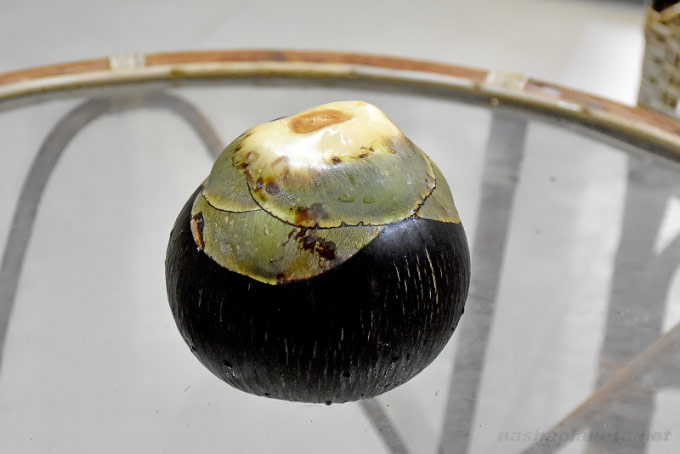
Palmyra

Palmyra (Palmyra palm, Talar, Borassus flabellifer) is a large fruit of dark purple or black color, 15-20 cm in diameter. A unique and very refreshing fruit, if you know how to choose and eat it correctly. Under the hard skin is juicy and very fibrous flesh, inside which hides 2-3 nut-like seeds with another layer of hard shell. The flesh and seeds contain carbohydrates, B and C vitamins, and minerals: potassium, calcium, and iron.
The fruit grows in almost all tropical countries and is considered the 'tree of life' in arid regions of Asia, as almost all of its parts are used for food. In addition to fresh fruits, sweet juice (nira) is extracted from the inflorescences, which is drunk fresh, boiled into palm sugar, or left to ferment to produce palm wine. Sprouted seeds (ongrung) are also a popular delicacy. But you can't find it on the markets everywhere. We have seen it in large quantities in Sri Lanka; it is also found in South India. In Thailand, Cambodia, Vietnam, Indonesia, Malaysia, it is almost never found, and if you look for it, it is only in local markets, not in tourist ones.
How to eat? Eating Palmyra fruits is not easy. The whole fruit has a hard skin that can be opened with a serious knife; a pocket knife will not help here. Under the skin will be juicy yellow flesh, but it is very fibrous. This flesh cannot be eaten, only the juice can be sucked out of it. But the problem is that if the fruit is not ripe, the flesh and juice will have a sweet-bitter, unpleasant taste. The most delicious and valuable is inside the dense seeds, but it is difficult to get to them through this fibrous flesh. If you do get there, these seeds also need to be opened, as they have a hard shell like a pit. If you get there, you will get a tasty refreshing jelly-like mass that you can eat with a spoon. Therefore, on the markets, you can sometimes find ready-made peeled seeds, which are the tastiest part of the fruit.
The season for fresh Palmyra fruits usually falls in the summer months.
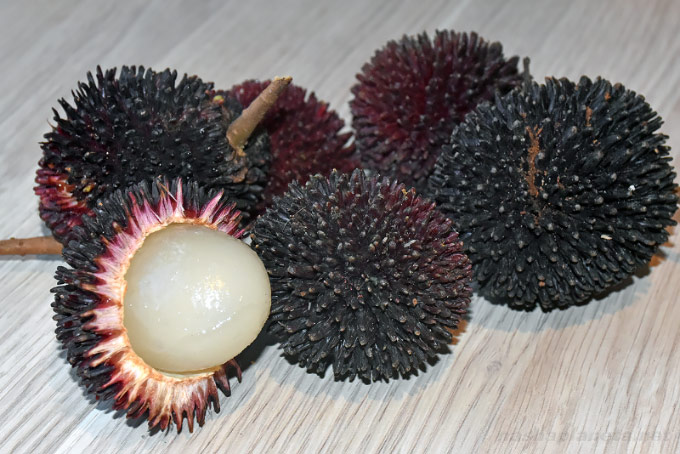
Pulasan

Pulasan or Pulazan (Pulasan, Kapulasan, 'twin of rambutan') is native to Malaysia, but is also found in other tropical countries. The fruits are very similar in appearance to rambutan, but differ in shorter and thicker 'hairs'. The color of a ripe fruit is a darker burgundy, almost black. Although it is called similar to rambutan, in fact it is very easy to distinguish them externally.
Pulasan also differs from rambutan in taste, but not much. The flesh is slightly juicier and with a sour note, like something between regular rambutan and lychee, but this difference is so small that not everyone can tell it. Inside the flesh there is a seed, which can also be eaten, but it is considered toxic raw, so you should not overdo it. An important feature: the skin of pulasan, especially unripe, releases sticky milky sap (latex) that stains your hands.
The fruits are rich in carbohydrates, iron, calcium, and vitamin C, and are valued for their high antioxidant content. Shelf life is about 1-2 weeks in a cool place, so you can easily bring them home. They are peeled the same way as rambutan: remove the skin by twisting. To make it easier, you can cut the skin a little, but this is not necessary.
The harvest season is usually from July to September, with a peak in August.
Mango plum or Maprang

Mango plum, Maprang, mini-mango, Marian plum, or Gandaria, Buea. All these are names of one exotic fruit and a relative of the common mango. However, important! Mini-mango is a 'folk' version of the name, but in fact mini-mangoes are bred small-sized varieties of ordinary mango.
The fruit is indeed remotely similar to mango in taste and color, but at the same time it is very different and costs two to two and a half times more. The fruits are small, 2-5 centimeters, the size of an ordinary plum. Covered with a thin skin, which, unlike ordinary mango, is edible. The flesh is softer and juicier than ordinary mango, rather just like plum flesh with a faint taste and aroma of mango. But there are no annoying hairs around the pit that get stuck in your teeth. The pit is small, hard, and inedible, but inside it there is an edible kernel.
You can find maprang for sale at least from January to July, but the ripening season, when the price of the fruit drops, falls in March and April. It keeps well and can be stored in the refrigerator for up to a couple of weeks, so this exotic fruit can easily be brought home.
Рейтин самых вкусных фруктов
1. Манго Отдали голоса - 6715 чел. или 8.2%
 Отдали голоса - 6602 чел. или 8%
 Отдали голоса - 6016 чел. или 7.3%
 Отдали голоса - 5293 чел. или 6.4%
 Отдали голоса - 4841 чел. или 5.9%
 Отдали голоса - 2905 чел. или 3.5%
 Отдали голоса - 2812 чел. или 3.4%
 Отдали голоса - 2810 чел. или 3.4%
 Отдали голоса - 2597 чел. или 3.2%
 Отдали голоса - 2517 чел. или 3.1%
 Отдали голоса - 2513 чел. или 3.1%
 Отдали голоса - 2425 чел. или 2.9%
 Отдали голоса - 2272 чел. или 2.8%
 Отдали голоса - 2113 чел. или 2.6%
 Отдали голоса - 2107 чел. или 2.6%
 Отдали голоса - 1954 чел. или 2.4%
 Отдали голоса - 1685 чел. или 2%
 Отдали голоса - 1573 чел. или 1.9%
 Отдали голоса - 1498 чел. или 1.8%
 Отдали голоса - 1400 чел. или 1.7%
 Отдали голоса - 1399 чел. или 1.7%
 Отдали голоса - 1308 чел. или 1.6%
 Отдали голоса - 1283 чел. или 1.6%
 Отдали голоса - 1271 чел. или 1.5%
 Отдали голоса - 1110 чел. или 1.3%
 Отдали голоса - 1110 чел. или 1.3%
 Отдали голоса - 1085 чел. или 1.3%
 Отдали голоса - 1072 чел. или 1.3%
 Отдали голоса - 1016 чел. или 1.2%
 Отдали голоса - 812 чел. или 1%
 Отдали голоса - 794 чел. или 1%
 Отдали голоса - 716 чел. или 0.9%
 Отдали голоса - 698 чел. или 0.8%
 Отдали голоса - 686 чел. или 0.8%
 Отдали голоса - 656 чел. или 0.8%
 Отдали голоса - 654 чел. или 0.8%
 Отдали голоса - 614 чел. или 0.7%
 Отдали голоса - 605 чел. или 0.7%
 Отдали голоса - 523 чел. или 0.6%
 Отдали голоса - 447 чел. или 0.5%
 Отдали голоса - 420 чел. или 0.5%
 Отдали голоса - 367 чел. или 0.4%
 Отдали голоса - 363 чел. или 0.4%
 Отдали голоса - 351 чел. или 0.4%
 Отдали голоса - 272 чел. или 0.3%
 Отдали голоса - 15 чел. или 0%
 Отдали голоса - 5 чел. или 0%
 Отдали голоса - 4 чел. или 0%
 Отдали голоса - 3 чел. или 0%
 Отдали голоса - 1 чел. или 0%